
Carrier general rate increases: how DTC brands should budget for 2027
The headline is 5.9%. On a typical DTC parcel mix the real number lands closer to 8%. Here's how to price next year's shipping before the first invoice arrives.
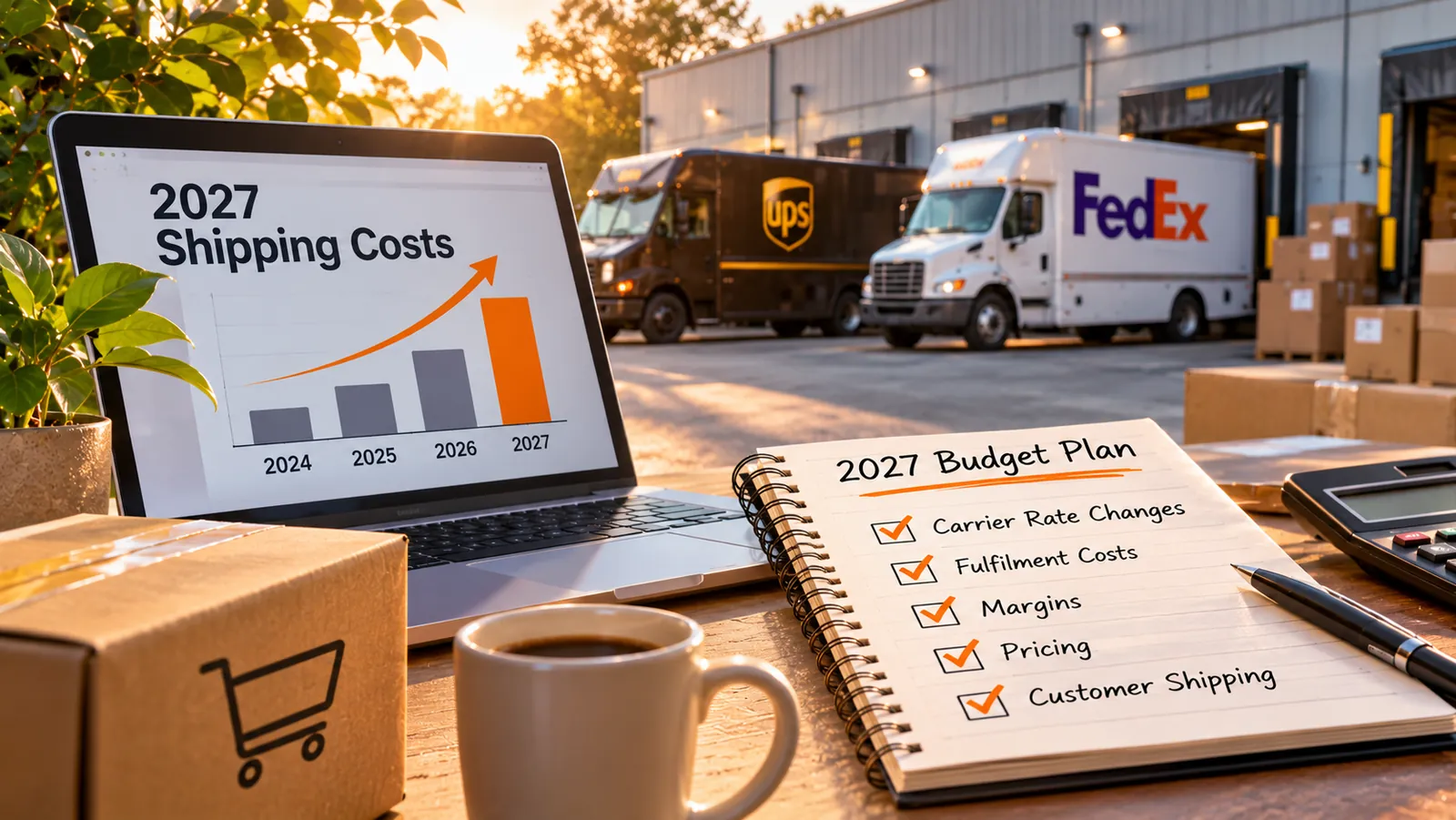
UPS raises its daily rates by an average of 5.9% on December 21, 2026, and FedEx raises its standard list rates by an average of 5.9% on January 4, 2027. Most residential and delivery area surcharges go up by 7% to 9%, so a typical DTC brand should budget for its UPS or FedEx bill to rise by about 7% to 8%.
USPS has proposed its own 5.9% increase from January 17, 2027. The exact number for your brand depends on your parcel mix, and this worksheet gets you to it in an afternoon.
Last checked: 23 November 2026. Rates are the carriers' published list rates and surcharges. Your contract discounts apply on top. Confirm your own figures with your carrier rep or 3PL.
UPS and FedEx are raising rates again. How should I plan for it?
Plan from your own invoices. The 5.9% headline is an average across every service, weight and zone, and your parcels don't sit in the average. Light residential parcels, the core of most DTC brands, usually rise faster than the headline.
Both carriers have announced the same 5.9% average every year since 2024, and 6.9% for 2023. Those increases compound, so a parcel that cost $10.00 at 2024 list rates costs about $11.88 in 2027, before surcharges.
Step 1: pull 12 months of shipments
Export every parcel you shipped in the last 12 months from your 3PL, your shipping software or your carrier account. You need five columns:
Service (for example UPS Ground, FedEx Home Delivery, USPS Ground Advantage).
Billed weight, after dimensional weight.
Zone.
Residential or commercial delivery.
Every surcharge on the parcel.
Step 2: reprice the base rates
Group the parcels by service, weight and zone, and reprice each group at the 2027 list rates. Most shipping software can do this once the carrier publishes its new rate files. If yours can't, apply 6.5% to light ground parcels as a working estimate. One analysis of FedEx's 2027 rate tables found 1 to 5 lb Ground parcels rose 6.49% on average, above the headline.
Your percentage discount doesn't soften this. A discount applies to the new list rate, so your net rate rises by the same percentage.
Step 3: reprice the surcharges separately
Surcharges are where the 2027 increase bites. At list price:
UPS residential surcharge (Ground): $6.50 to $7.10.
FedEx residential delivery (Ground): $6.45 to $6.90.
UPS delivery area surcharge, residential: $6.55 to $7.15.
FedEx delivery area surcharge, residential: $6.60 to $7.00. Extended: $8.80 to $9.60.
UPS Large Package, commercial: up 11.7% to 15.4%.
Two rule changes matter as much as the prices. UPS raises the minimum billable weight for Additional Handling parcels from 40 lb to 50 lb on December 21, 2026. UPS is also changing some shipping zones and delivery area ZIP codes, so check whether your main lanes moved.
FedEx adds a $25 fee from January 18, 2027 when a trade document for an international shipment is provided on paper. If your 3PL still prints paper forms for any shipments, ask them to switch to electronic documents now.
A worked example
Take a made-up skincare brand shipping 3,000 UPS Ground parcels a month, all to homes, averaging $9.40 in base postage at list price. One in five parcels goes to a delivery area surcharge ZIP code.
Base postage: $28,200 a month, rising 6.5% to $30,033.
Residential surcharges: 3,000 parcels at $6.50 is $19,500, rising to $21,300 at $7.10.
Delivery area surcharges: 600 parcels at $6.55 is $3,930, rising to $4,290 at $7.15.
The monthly bill goes from $51,630 to $55,623, an increase of $3,993 or 7.7%. Over a year that's about $48,000. The headline would have predicted $3,046 a month, so planning on 5.9% would have left the brand about $11,000 short for the year.
Step 4: cut what you can before January
Size your boxes to the parcel. Carriers bill on dimensional weight when a box is large and light. Our guide to volumetric weight shows how to check which SKUs are paying for air.
Stay under the Additional Handling thresholds. If a parcel sits just over a size or weight trigger, a packaging change can take it out of the surcharge entirely.
Move light parcels to the cheapest service. USPS Ground Advantage is often cheaper for parcels under 1 lb. USPS has proposed a 5.9% average increase and a permanent 11% fuel surcharge from January 17, 2027, so reprice it at the new rates before you switch.
Shorten your zones. A second warehouse cuts the average zone and the transit time. Our guide to two-day shipping without Amazon shows when it pays.
Use your 3PL's rates. Many 3PLs pool the volume of all their clients and get carrier rates a single brand can't. Ask for a quote on the same 12 months of parcels.
Negotiate the surcharges as well as the discount. Residential and delivery area surcharges can be discounted in a contract. Our guide to UPS and FedEx surcharges covers what each one is for.
Step 5: check the first invoices
New rates bring billing errors: wrong zones, duplicate surcharges, and dimensional weight on parcels that were measured incorrectly. Compare the first two invoices of 2027 with your repriced worksheet line by line. Our guide to auditing carrier invoices lists what to look for.
People also ask
When does the UPS 2027 rate increase start?
On December 21, 2026, with an average increase of 5.9% on daily rates. The new minimum billable weight for Additional Handling parcels starts the same day.
When does the FedEx 2027 rate increase start?
On January 4, 2027, with an average increase of 5.9% on standard list rates. Most surcharges change the same day.
Is USPS raising prices in January 2027?
Yes, if the regulator approves it. On November 12, 2026, USPS proposed a 5.9% average increase on Priority Mail, Priority Mail Express, Ground Advantage and Parcel Select from January 17, 2027. It also plans to turn its temporary 8% surcharge into a permanent 11% fuel surcharge.
Next step: export your last 12 months of shipments this week and reprice them at the 2027 rates. Then Ask Logan on fulfilq.com for US 3PLs whose carrier rates beat your own for that parcel mix.
Sources: D'Arrigo Consulting, 2027 shipping rate increases; ebb logistics, UPS and FedEx rate increase history; Supply Chain Dive, UPS 2027 rate increase; Supply Chain Dive, FedEx 2027 rate increase; USPS, 2027 shipping price proposal (November 12, 2026).
Need a logistics partner?
Tell Logan what you ship and where, and get a shortlist of partners that fit.
Submit an RFP

Comments
Share a question or insight about this article.