
Matching Amazon-speed delivery without Amazon: building a 2-day ground network
Two-day delivery is a network decision before it is a carrier decision. A board-level look at the three setups that get you there, and when each one pays.
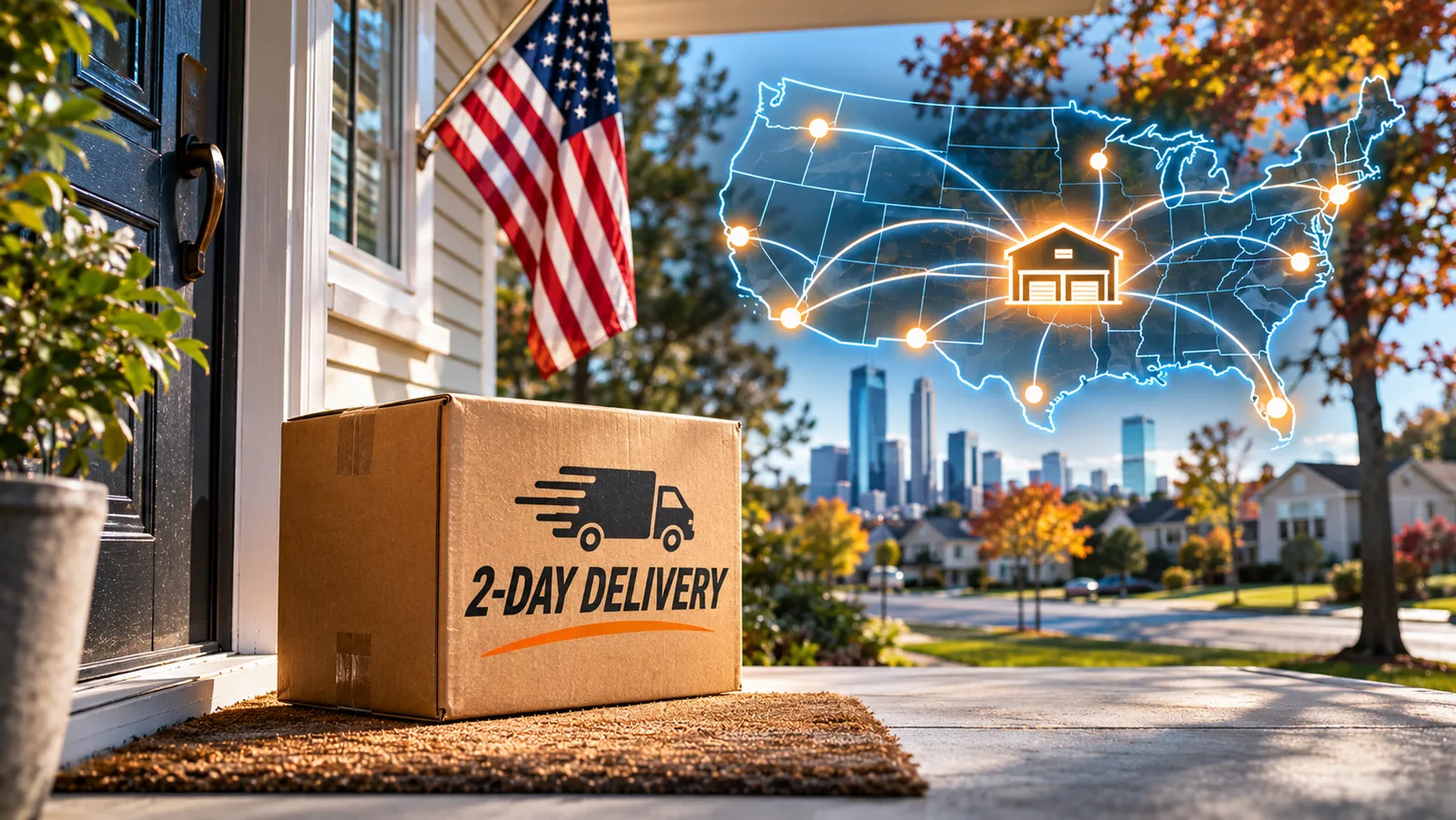
Most US brands can offer 2-day delivery to most of their customers using ground services, provided the stock sits close enough to the buyers. In practice that means one centrally located warehouse with late carrier pickups, or two warehouses, one on each side of the country. The right choice depends on where your orders actually go.
When a founder brings me this question, it usually arrives as "which carrier is fastest?" The distance between your stock and your customer decides most of the answer, and carrier choice fine-tunes it. FedEx says its Ground service takes 1 to 5 business days across the contiguous US, depending on distance, and USPS Ground Advantage runs 2 to 5. The day count follows the miles, so the network comes first and the carrier second.
Option A: one central warehouse
A warehouse in the middle of the country, in markets like Memphis, Louisville, Indianapolis or Dallas, keeps the longest trips shorter. Pair it with a late carrier pickup and a same-day dispatch cut-off, and 2-day ground covers a large share of the population.
Good for: brands with customers spread evenly across the country, and anyone under a few thousand orders a month.
Watch for: the coasts. Orders to the West Coast and New England sit at the long end of ground transit, so those customers may see three days.
Option B: two warehouses, one per coast
Split stock between an East and a West site and most orders drop into low zones, which brings both faster delivery and lower postage.
Good for: brands with heavy demand on both coasts and enough volume to keep two sites stocked.
The cost: more inventory in total, because each site needs its own safety stock. You also pay for two inbound shipments, two storage bills and more forecasting work. Running out at one site while the other is full is the classic failure.
Option C: one warehouse plus paid speed
Keep a single site and upgrade only the orders that need it: air services for the far zones when the order value can carry it, or regional carriers that move faster than national ground in their own area.
Good for: high-value orders, testing demand for faster delivery, and brands that aren't ready to split stock.
Watch for: margin. Air upgrades on low-value orders can cost more than the order earns.
What I would recommend
Start with Option A unless your data says otherwise, because it gives the most speed for the least complexity. Move to Option B when a large share of your orders sits in the far zones from your current site and the postage saved, plus the conversion lift from faster delivery, covers the cost of the extra stock. Use Option C as a bridge while you find out whether customers will pay for speed.
Here's a made-up example of that test. A brand ships 8,000 orders a month, and 3,200 of them go 1,400 miles or more. If a West Coast site saves $3 in postage on each of those, that's $9,600 a month. The second site adds storage, an extra inbound freight leg and more safety stock, say $6,000 a month all in. The move pays before counting any conversion lift.
The hidden cost of two warehouses
Splitting stock is where Option B gets expensive. Each site needs its own buffer for demand swings, and two buffers add up to more total stock than one, because the swings no longer cancel out across the whole country. Slow-moving SKUs are the worst case: a line that sells ten units a month nationally may sell four on one coast and six on the other, and both sites still need a minimum on hand.
A practical way round it is to split only your fastest sellers between two sites and keep the long tail in one. The top 20% of SKUs often make up most of the orders, so most customers get 2-day delivery without doubling every line.
The promise matters as much as the network
Show a delivery date, worked out from the customer's ZIP code, your cut-off time and the carrier's transit days. Show "2-day" only where it's true. A promise kept for 80% of customers beats one made to everyone and broken for a third of them.
Questions to ask each 3PL
What share of my last 90 days of orders would your site reach in 2 business days by ground?
What's your same-day dispatch cut-off, and does it change in peak?
Which carriers do you rate-shop per parcel, and do you use regional carriers?
If I use two of your sites, how do you split inbound stock, and what does a transfer between sites cost?
Can you report my on-time rate against the promised date each month?
The last answer matters most. If a provider can't measure on-time delivery, you can't keep the promise you put in your checkout.
How to decide in a week
Map 90 days of orders by destination state.
Ask two or three 3PLs for the share of your orders each of their sites reaches in 2 days by ground.
Price Option A and Option B side by side, including the extra safety stock.
Our guide to regional vs. centralized fulfillment covers the inventory side in more depth, and questions to ask a 3PL helps with the conversations. To compare central and two-coast quotes, Submit an RFP with your order map attached.



Comments
Share a question or insight about this article.