
Retail chargebacks and routing guides: how US brands lose margin on compliance
Your first big retail order can lose its margin to deductions before the invoice is even paid. A field guide to the six chargebacks we see most often.
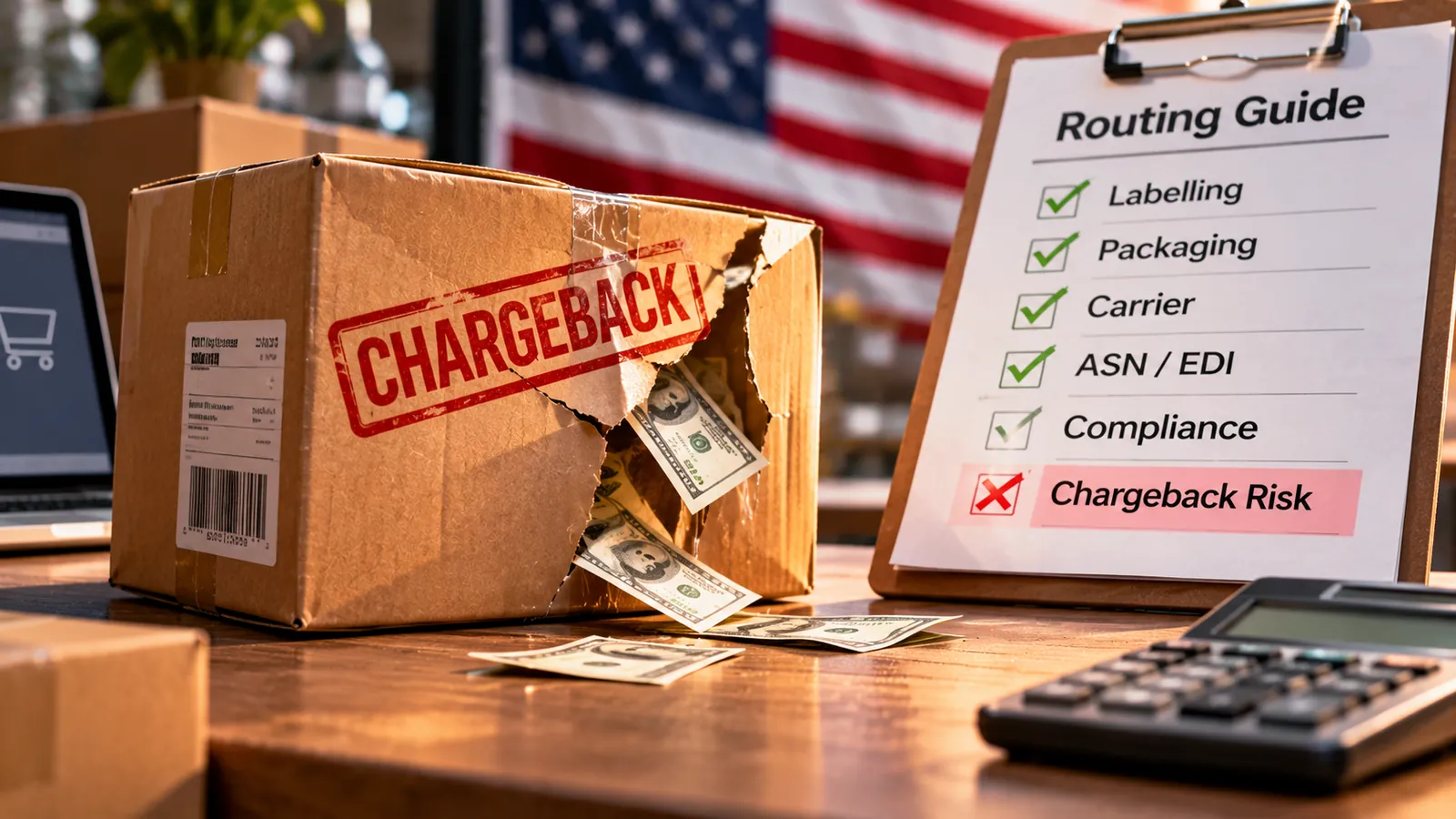
Retail chargebacks are deductions a retailer takes off your invoice when a shipment breaks its routing guide: it arrives late, comes up short, carries the wrong labels or has an advance ship notice that doesn't match the truck. Walmart fines 3% of the cost of goods on every case that misses its on-time or in-full targets.
For a DTC brand landing its first big retail account, these deductions are often the surprise that turns a good order into a weak one. They arrive weeks after the shipment, with little explanation, and they come straight off what the retailer pays you. Most of them trace back to a handful of warehouse habits, and every one of those habits can be fixed before the first PO ships.
Last checked: 15 November 2026. Walmart figures as summarized in Beancount's October 2026 OTIF guide. Confirm the current terms in your own supplier agreement and Retail Link scorecard.
What a routing guide controls
Every big-box retailer publishes a routing guide. It sets the rules for how freight arrives: appointment windows, carton labels, pallet builds and the advance ship notice, the EDI 856. The guide is part of your supplier agreement, so breaking any rule in it gives the retailer the right to deduct.
Guides run to dozens of pages and change several times a year. The brands that avoid chargebacks treat the guide as a working document for the warehouse team, turned into checklists at the packing station, and review each update when it lands.
Why DTC warehouses struggle with retail
Most DTC warehouses are built to pick single items into parcels. Retail orders ask for something different: full cases, built onto pallets to a set pattern, labeled to one retailer's standard and delivered inside a fixed appointment. A warehouse that does this rarely will make mistakes on the first few POs, and each mistake is a deduction.
That's why the first question for your 3PL is how many retail POs it ships each week, and to which retailers. A provider that ships to your retailer every week already has the labels, pallet builds and appointment habits in place.
Late or early arrival
Walmart scores on-time delivery case by case. For prepaid freight, the truck has to arrive inside the window around the PO's must-arrive-by date, and the target is 90% of cases. When Walmart collects, freight has to be staged and ready by the must-release-by date, and the target is 98%.
The fix is to work ship dates backward from the arrival window, book the carrier appointment the day the PO lands, and flag on day one any PO the warehouse can't make. A date change requested early usually costs nothing. A late truck costs 3%.
Short shipments
The in-full target is 95% of cases. Shortages are also the biggest source of deductions overall: about 80% of off-invoice US retail deductions are shortage claims, according to Beancount's guide to retailer deductions. Count at pack-out, photograph every pallet before it's wrapped, and get the case count written on a signed bill of lading. When a shortage claim arrives, that paperwork is your defense.
ASN errors
The advance ship notice tells the retailer exactly what's on the truck. If it doesn't match what arrives, receiving slows down and deductions follow. Generate the ASN from the scanned pack-out data, never from the purchase order, so that a line shipped short shows up as short on the ASN as well.
Label and carton-marking errors
Retailers specify carton labels down to the barcode type and where it sits on the box. An unreadable barcode or a label on the wrong face means manual handling at the distribution center, and a charge for it. Test-print labels for each new retailer, scan them before the first shipment, and run a label check on every outbound pallet.
Purchase order accuracy
Walmart's supplier quality program charges $200 for each defective PO plus $1 per affected case, so shipping 100 cases over the ordered quantity on one PO costs $300. Ship to the latest PO version only, and hold any order where the pick quantity and the PO disagree until someone confirms it.
Pallet and packaging violations
Overhang, pallets built too tall, mixed SKUs without labels and damaged pallets all appear in routing guides, with fees that vary by retailer. Turn the guide's pallet rules into a one-page build sheet at the packing station, with a photo of a correct pallet for each retailer.
What it adds up to
The guide's own example is 300 cases at $30 cost of goods, fined at 3%, which comes to $270. That looks small on one PO. Take a made-up brand that misses on one weekly PO of that size every week for a quarter: 13 POs come to $3,510 in on-time fines alone, before any PO accuracy charges or shortage claims. Across a year and several retailers, the total can reach the margin on an entire product line.
New Walmart suppliers get three months where OTIF fines are tracked on the scorecard and waived. Use that window to fix the process while mistakes are still free.
Read your scorecard every week
Walmart's Retail Link scorecard shows OTIF performance by PO, and other retailers publish their own vendor scorecards. Review them weekly with your 3PL, PO by PO, and agree the cause of every miss. Patterns appear quickly: the same carrier late every Tuesday, the same SKU always short, the same label failing at one distribution center. Each pattern has a single fix, and fixing it stops the deduction repeating.
Dispute fast
Timing decides most disputes. The guide reports win rates of 75 to 80% in the first week after a deduction, and under 5% after 90 days. Walmart disputes go through HighRadius and usually resolve in 30 to 45 days. A won dispute refunds the money, though your OTIF score stays as it was.
The controls to ask your 3PL for
Ship dates planned backward from each PO's arrival window, with carrier appointments booked the day the PO arrives.
Case counts at pack-out, pallet photos before wrapping, and signed bills of lading showing the count.
ASNs built from scanned pack-out data.
Label test prints for each new retailer and a label scan on every outbound pallet.
An evidence pack saved for every PO: the final PO version, the ASN log, the bill of lading and the carrier's proof of delivery.
Its on-time and in-full record for each retailer it ships to today.
Our guide to fulfilling retailer purchase orders covers the rest of the retail workflow. If you need a warehouse that already ships to your retailers, Logan can shortlist 3PLs with retail compliance experience from your channels and volumes.
Need a logistics partner?
Tell Logan what you ship and where, and get a shortlist of partners that fit.
Submit an RFP

Comments
Share a question or insight about this article.