
UPS and FedEx surcharges explained
Current UPS and FedEx fuel, peak-season, additional handling and oversize surcharges, and the dimensional weight divisor each one bills on, for 2026.
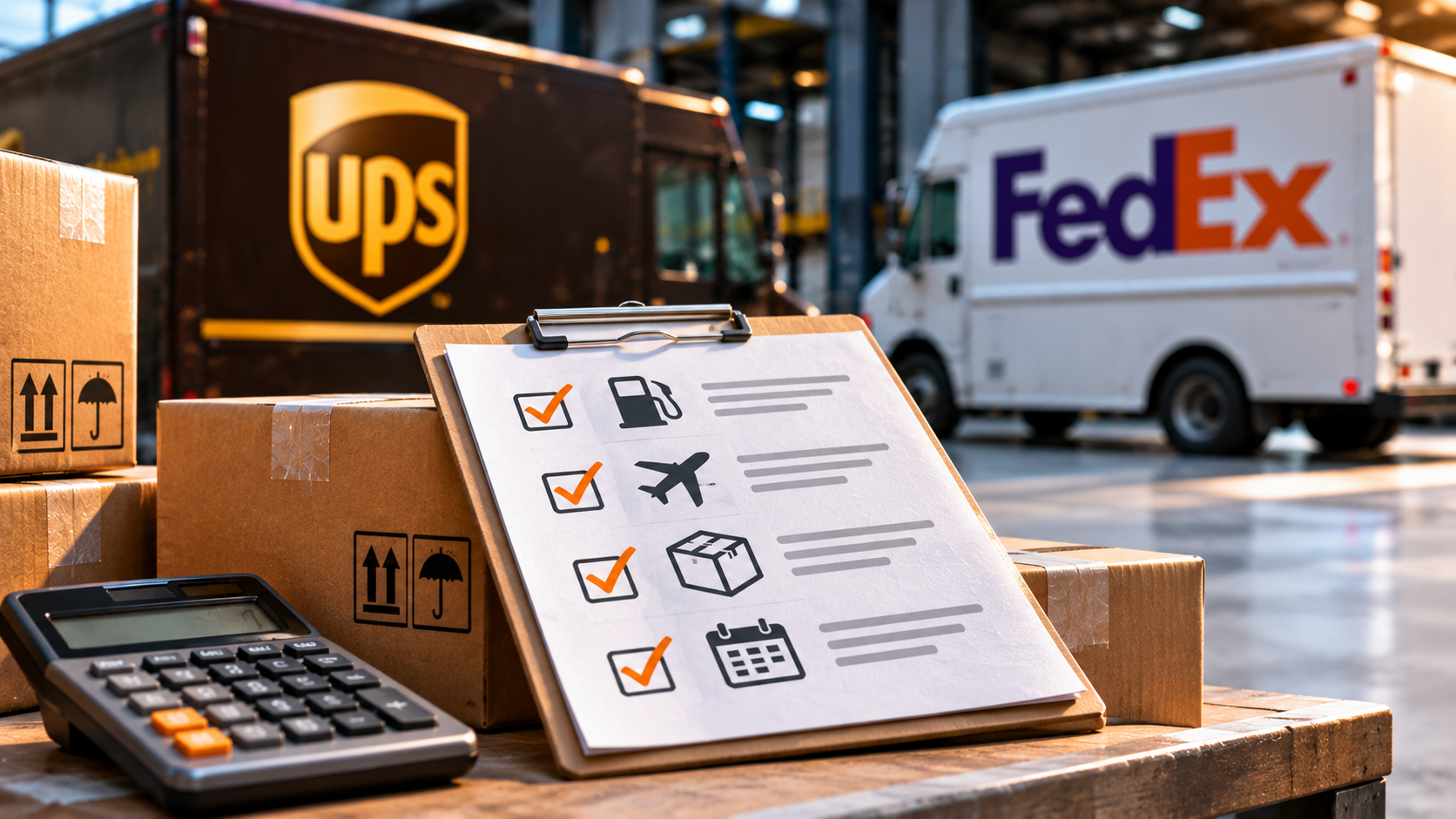
UPS and FedEx add fuel, peak-season, handling, oversize and address correction surcharges on top of the base rate you were quoted, and most change weekly or seasonally. As of early November 2026, fuel alone adds roughly 30% to ground shipments and over 45% to international air, before any other surcharge applies.
Last checked: 7 November 2026, against each carrier's own published rate pages. These figures move every week for fuel and every few months for everything else, so check the carrier's own current page before you quote a customer or set a margin.
The pain points
"Our quote said one price and the invoice runs well above it every week."
"I can't tell if the fuel percentage on our bill is even current, since it changes so often."
"Every box over a certain size gets hit with a charge nobody warned us about."
"A peak season surcharge landed on an invoice we never budgeted for."
"I don't know which dimensional weight divisor actually applies to our account."
Fuel surcharges: indexed and adjusted weekly
Both carriers tie their fuel surcharge to a government fuel price index, with a short lag, and republish the rate every week. FedEx indexes Ground, Home Delivery and International Ground to the weekly EIA US on-highway diesel price, and its other domestic package services to the weekly EIA Gulf Coast jet fuel price. For the week of November 2 to 8, 2026, that puts FedEx at 29.25% for Ground and Home Delivery, 33.25% for other domestic package services, and 45.75% for Export and Import.
UPS indexes Ground and Ground Saver to the weekly EIA national average diesel price, and Domestic Air to the weekly EIA Gulf Coast jet fuel price, both adjusted every Monday. For the week starting November 2, 2026, UPS's surcharge is 30.25% for Domestic Ground, 34.25% for Domestic Air, 46.25% for International Air Export and 49.00% for International Air Import. Because both carriers republish weekly, treat every figure here as a snapshot and check the carrier's own current table before you invoice a customer.
Peak season demand surcharges, and this year's dates
Both carriers run three pricing windows this peak season, a shoulder period, a "peak of peak," then a tail, with FedEx's dates one day later than UPS's: FedEx runs October 26 to November 22, 2026, then November 23 to December 27 at its highest rate, then December 28 to January 17, 2027; UPS runs October 25 to November 21, then November 22 to December 26, then December 27 to January 16.
Ground residential demand surcharges step up and back down across those three windows: FedEx's Ground and Home Delivery Residential Demand surcharge runs $0.50, then $0.80 at peak, then $0.50 a package; UPS's Ground Saver and Ground Residential demand surcharge runs the same $0.50, $0.75, $0.50 pattern. Air demand surcharges follow the same shape at a higher level: FedEx's First, Priority and Standard Overnight demand surcharge runs $1.30, $2.55, $1.30; UPS's Next Day Air and other air demand surcharge runs $1.35, $2.50, $1.35.
These demand surcharges stack on top of the standard handling and oversize charges below during each window, so one oversized parcel can carry more than one surcharge at once in peak. Both carriers also run a steeper table for accounts shipping over 20,000 packages a week; most FulfilQ-size brands won't hit this, but ask your 3PL if your combined volume might.
Additional handling surcharge
FedEx triggers its Additional Handling Surcharge on a package whose longest side is over 48 inches, second-longest side over 30 inches, length plus girth over 105 inches, cubic size over 10,368 cubic inches, actual weight over 50 lbs domestically or 55 lbs internationally, or non-standard packaging. UPS's triggers are almost identical, with the same weight, length, girth, width and cubic thresholds. UPS applies only one Additional Handling charge per package, in a set priority order, and waives it if the Large Package surcharge applies instead.
Charges scale by zone and by which trigger applied. FedEx's U.S. Package Services charge runs roughly $26 to $59 depending on zone and whether it's a dimension, weight or packaging trigger; UPS's domestic charge runs a very similar $27 to $59. Internationally, FedEx charges $29.50 to $40 depending on the trigger; UPS charges a flat $36.35. From December 21, 2026, UPS raises the minimum billable weight for a dimension-triggered charge from 40 lbs to 50 lbs.
Large package and oversize surcharge
FedEx's Oversize Charge triggers on a longest side over 96 inches, length plus girth over 130 inches, cubic volume over 17,280 cubic inches, or weight over 110 lbs, charging $255 to $330 by zone. A separate Ground Unauthorized Package Charge of $1,875 applies to anything over 108 inches long, over 165 inches length plus girth, or over 150 lbs.
UPS's Large Package Surcharge uses the same basic triggers, charging $219.50 to $331 domestically depending on zone and whether the account is commercial or residential, and a flat $235 internationally. Its Over Maximum Limits charge of $1,875 applies to anything over 150 lbs, over 108 inches long, or over 165 inches length plus girth, and those packages are refused for transport rather than simply surcharged.
Residential delivery and address correction
Outside peak season, FedEx's standard residential delivery charge is $6.45 a package for Ground, Home Delivery and International Ground, and $6.95 for US Express Package Services. UPS charges $6.50 for domestic Ground and $7.00 for domestic Air, with $6.45 to $6.80 internationally depending on service. These are separate line items from the peak-season residential demand surcharges above, so a parcel shipped during peak can carry both at once.
For address correction, FedEx charges $25.50 per correction, or $130 for US Express Freight Services. UPS charges $25.25 per correction on Package and Worldwide Express Freight Services, up to $175.25 per shipment on UPS Ground with Freight Pricing.
Dimensional weight divisor
FedEx divides length times width times height in inches by 139 for essentially all domestic and international package and freight services, except FedEx International Deferred Freight, which uses 166. UPS divides by 139 for its account-based Daily Rates, covering both domestic and international shipments, but by 166 for its walk-in Retail Rates. If you ship on a 3PL's or your own UPS account, you're almost certainly on the 139 divisor; confirm which rate type applies before you estimate a shipping cost.
Other changes landing around now
Both carriers added a cubic-volume trigger to their additional handling and oversize rules in January 2026, and both have announced year-end rate increases averaging a net 5.9%: UPS's lands December 21, 2026, alongside the Additional Handling weight-limit change above; FedEx's lands January 4, 2027, alongside new paper document and air waybill fees from January 18, 2027. These move every year, so re-check both carriers' own rate pages before you budget for the new year, not just for this peak season.
What to ask your 3PL or carrier rep
Which fuel surcharge percentage applies to our account today, and how often do you re-check it against the carrier's published table?
Do our typical box sizes and weights trigger additional handling or oversize charges, and would a smaller box avoid it?
Which peak-season window are we shipping in right now, and does our invoice reflect that one?
Are we on the 139 or 166 dimensional weight divisor, and does that match what we were quoted?
Has either carrier's year-end rate increase been applied to our account yet?
Our recommendation: check your invoices against the carriers' own current tables
Pull your last three invoices from each carrier and check the fuel percentage charged against that week's published rate.
Measure your top SKUs against both carriers' additional handling and oversize triggers, and rebox anything close to a threshold.
Mark your calendar for each peak-season window and the year-end rate increase, and rebuild your shipping cost model for each.
Confirm which dimensional weight divisor applies to your account, not your walk-in retail rate.
Ask your 3PL to show surcharges as separate invoice lines, matched to tracking numbers, so you can audit them.
What waiting costs
Every week you budget on an old fuel percentage, or a box size that trips a surcharge you didn't know about, understates your real landed cost per parcel.
These figures are made up to show the method. A brand ships 5,000 parcels a month and budgets fuel at 25% when the current rate is closer to 30%. On an average $8 base rate, that's $0.40 a parcel it didn't account for, or $2,000 a month. If 4% of its parcels also trip the additional handling charge at roughly $30 each, that's another $6,000 a month. Catching both in the budget, not the invoice, is the difference between a margin that holds and one that doesn't. These figures are made up to show the method.
People Also Ask
Why does my UPS or FedEx fuel surcharge keep changing?
Because it's indexed to a weekly government fuel price, with a short lag, and republished every week. Both carriers update these tables weekly on their own sites, so a rate you saw a month ago is very likely out of date.
Do peak season surcharges apply on top of additional handling and oversize charges?
Yes. During each carrier's published peak windows, the demand surcharges for additional handling, oversize and similar charges stack on top of the standard version of those charges, so a single oversized parcel can carry more than one surcharge at once during peak.
Which dimensional weight divisor should I use to estimate shipping cost?
For an account-based rate with either carrier, 139 is the divisor for both domestic and international shipments; 166 only applies to UPS's walk-in retail rate and FedEx's international deferred freight service. Confirm which applies to your account before you estimate.
Finding the right 3PL partner
Logan, FulfilQ's advisor on the website, matches brands to verified providers by order volume, product type and region. Tell Logan your typical box sizes, weights and monthly parcel volume, and you get a shortlist to ask about current carrier surcharges and how they show up on your invoice. Start at fulfilq.com and Ask Logan, or Submit an RFP and verified providers come back to you. You can also browse the full provider directory.




Comments
Share a question or insight about this article.