
How to Ship Lithium Batteries from the UK: A Guide for Ecommerce Brands
Ship gadgets with lithium batteries from the UK: UN numbers, UN 38.3, watt-hour limits, the 2026 IATA 30% charge rule and what Royal Mail accepts.
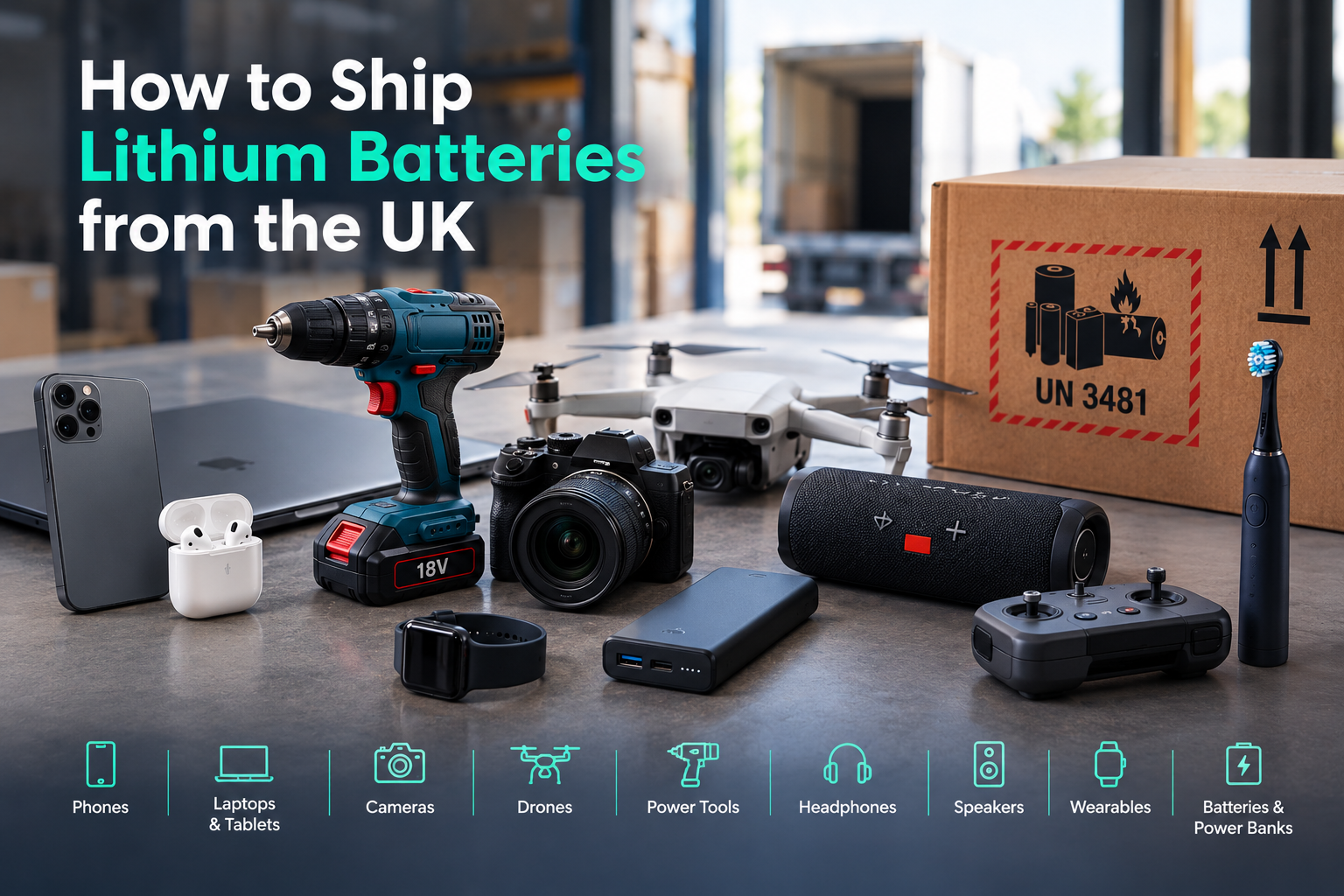
To ship lithium batteries from the UK, start by working out what you are sending: batteries on their own, batteries packed in the box with a device, or batteries fitted inside a device. That choice sets the UN number, the size limits, the marking and which carriers will take the parcel. Consumer electronics with small batteries fitted inside can go by road and post within set limits. Loose batteries face the strictest rules, and Royal Mail refuses them outright.
This guide covers the rules as they stand in October 2026. Carrier terms change often, so check with your carrier before you ship.
The pain points
A courier sent our parcels back and nobody told us why until a week later.
We sell spare batteries and Royal Mail won't take them.
Our supplier can't find the UN 38.3 test summary.
We don't know if our warehouse can ship these.
A customer returned a swollen battery and we don't know what to do with it.
Step one: classify what you ship
Each product in your range sits under one of four UN numbers.
UN3480: lithium-ion batteries on their own. IATA treats a power bank as a battery, so it ships under this number.
UN3481: lithium-ion batteries packed with equipment, or contained in equipment.
UN3090: lithium metal batteries on their own. These are usually non-rechargeable, such as coin cells.
UN3091: lithium metal batteries packed with equipment, or contained in equipment.
"Packed with" means in the same box and unfitted, such as a camera with a spare battery. "Contained in" means fitted, such as a phone or wireless earbuds.
Get the test summary and check the size limits
Every cell and battery type must pass the tests in the UN Manual of Tests and Criteria, Part III, subsection 38.3, and manufacturers and distributors must make the test summary available. Ask your supplier for it before you order stock. Without it, carriers and 3PLs can refuse the product.
The lighter rules for small batteries apply only within these limits:
Lithium-ion: 20 Wh or less per cell and 100 Wh or less per battery. If the battery shows only volts and amp-hours, multiply the nominal voltage by the amp-hours.
Lithium metal: 1 g of lithium or less per cell and 2 g or less per battery.
Larger batteries are fully regulated Class 9 dangerous goods, and far fewer services carry them.
Air freight: the 2026 state of charge rules
International express parcels often travel by air. The IATA Dangerous Goods Regulations, 67th edition, apply from 1 January 2026:
Lithium-ion batteries on their own (UN3480, Packing Instruction 965) must be at 30% state of charge or less. They are forbidden as cargo on passenger aircraft and need a Cargo Aircraft Only label.
Lithium-ion batteries packed with equipment (UN3481, Packing Instruction 966) must also be at 30% or less from 1 January 2026. Under Section II, this covers cells and batteries above 2.7 Wh.
Lithium-ion batteries contained in equipment (UN3481, Packing Instruction 967): IATA strongly recommends 30% or less.
Lithium metal batteries on their own (UN3090) are also forbidden as cargo on passenger aircraft.
Damaged, defective or recalled batteries are forbidden by air where they could overheat, catch fire or short circuit.
A warehouse cannot easily test the charge of sealed stock, so agree reduced charge with your factory in writing. The full detail is in the IATA lithium battery guidance document.
Road under ADR, and what Royal Mail accepts
Road transport in Great Britain follows ADR, applied through the Carriage of Dangerous Goods regulations. Small batteries within the limits above can use ADR special provision 188: short circuit protection, strong outer packaging, a 1.2 m drop test for anything other than batteries fitted in equipment, a 30 kg gross limit for packages of batteries on their own, and the lithium battery mark. A package with no more than four cells or two batteries fitted in equipment needs no mark, where the consignment has no more than two such packages. Damaged or defective batteries cannot use special provision 188.
Royal Mail's prohibited and restricted items guidance is tighter:
Loose batteries without equipment are prohibited, in the UK and internationally.
Batteries fitted in equipment are accepted in the UK and to some international destinations, with no more than four cells or two batteries per parcel.
Batteries packed with equipment are accepted in the UK only. The limit is the number needed to power the device plus two spares, each battery fully enclosed, with a lithium battery handling label. They are prohibited internationally.
All batteries must sit within the size limits above, with no more than 5 kg of batteries per parcel. They must pass UN 38.3, and damaged cells are forbidden.
Royal Mail updates these rules and business account terms can differ, so check its current guidance. DPD, Evri, DHL, UPS and Parcelforce Worldwide each publish their own lists. Get your carrier's acceptance in writing for each UN number you ship.
Plan for returns too. A swollen battery cannot travel by air or under special provision 188, so ask customers to contact you first and use a carrier that handles damaged batteries. Our guide to returns policy costs shows how to write that into your policy.
What to ask a 3PL about lithium batteries
Do your staff hold dangerous goods training for road and air, and who is your dangerous goods safety adviser?
Which of your carrier accounts accept UN3481 and UN3091, and can any service take UN3480 or UN3090?
How do you store lithium stock, and what fire detection and insurer quantity limits apply?
Do you apply the lithium battery mark and keep test summaries on file for each SKU?
How do you handle damaged or returned batteries?
Add these to your standard questions to ask a 3PL, and see our guide to choosing a 3PL in the UK for the wider checklist.
Our recommendation: build a battery file for every SKU
List each product's battery chemistry, watt-hours or lithium content, battery count, and whether batteries are fitted, packed with or loose.
Collect the UN 38.3 test summary for every battery type from your supplier. No summary, no stock.
Assign the UN number and check it against Royal Mail's guidance and each carrier's list.
Ask your factory to ship lithium-ion stock at 30% charge or less, and keep its confirmation.
Send the file to your 3PL shortlist with the five questions above.
Write a returns rule for damaged batteries before the first one arrives.
What waiting costs
A wrongly classified battery shipment can be refused, returned or held, and a carrier can suspend an account that keeps sending them. Breaches of the Carriage of Dangerous Goods regulations can lead to enforcement action, and a damaged battery can start a fire in a van or a warehouse.
These figures are made up to show the method. A brand sends 80 international parcels a week of a speaker with a spare battery in the box, and its service turns out to refuse batteries packed with equipment. At £6 a parcel in return postage and repacking, that is £480 a week, before refunds and lost reviews.
People Also Ask
Can you post lithium batteries with Royal Mail?
Yes, within limits. Royal Mail accepts batteries fitted in equipment in the UK and to some international destinations, and batteries packed with equipment in the UK only. Loose batteries are prohibited. Check its current guidance.
What is UN3481?
UN3481 covers lithium-ion batteries packed with equipment or contained in equipment. Most rechargeable gadgets use it. Lithium-ion batteries on their own, including power banks, ship as UN3480.
Do lithium batteries need to be at 30% charge to ship?
By air, lithium-ion batteries on their own must be at 30% or less, and from 1 January 2026 so must lithium-ion batteries packed with equipment. For batteries fitted in equipment, IATA strongly recommends 30% or less. For road and post, check with your carrier.
Finding the right dangerous goods fulfilment partner
Logan, FulfilQ's advisor on the website, matches brands to verified providers by order volume, product type and region. Tell Logan what you ship and where, and you get a shortlist to ask about dangerous goods training, battery-friendly carrier accounts and safe storage. Start at fulfilq.com and Ask Logan, or Submit an RFP and verified providers come back to you. You can also browse the full provider directory.


Comments
Share a question or insight about this article.