
Order Fulfilment Explained: From Checkout to Doorstep
When a customer clicks “Buy Now”, most ecommerce brands celebrate the sale. What happens next often receives far less attention. Yet the period between checkout and delivery is where brands either strengthen trust or damage it. Customers rarely see your warehouse. They rarely meet your fulfilment team. They do not care which courier software you use. However, they absolutely notice when an order arrives late, damaged or incorrect. That is why understanding order fulfilment is so important

When a customer clicks “Buy Now”, most ecommerce brands celebrate the sale.
What happens next often receives far less attention.
Yet the period between checkout and delivery is where brands either strengthen trust or
damage it.
Customers rarely see your warehouse.
They rarely meet your fulfilment team.
They do not care which courier software you use.
However, they absolutely notice when an order arrives late, damaged or incorrect.
That is why understanding order fulfilment is so important.
For many ecommerce businesses, order fulfilment is the invisible engine that powers
growth. When it runs smoothly, customers come back. When it breaks down, problems
appear quickly.
This guide explores the complete order fulfilment process, the stages involved,
common challenges and how growing brands can improve operational performance.
What Is Order Fulfilment?
Order fulfilment is the complete process of receiving, processing, packing and
delivering customer orders.
It starts the moment an order is placed and ends when the customer receives their
purchase.
In many cases, the fulfilment journey also includes returns processing and inventory
updates.
The typical order fulfilment process includes:
- receiving inventory
- storing products
- processing orders
- picking items
- packing parcels
- shipping products
- handling returns
Although this sounds straightforward, every stage introduces opportunities for delays,
errors and inefficiencies.
Why Order Fulfilment Matters
Order fulfilment affects far more than logistics.
It influences:
- customer satisfaction
- repeat purchases
- reviews
- refunds
- operational costs
- brand reputation
Consequently, fulfilment performance often becomes a competitive advantage.
In highly competitive ecommerce markets, products can be copied and advertising
strategies can be replicated.
Exceptional fulfilment is much harder to replicate consistently.
The Link Between Fulfilment and Customer
Loyalty
Research from PwC found that 73% of consumers say customer experience is an
important factor in purchasing decisions.
Source:
https://www.pwc.com/us/en/services/consulting/library/consumer-intelligence-
series/customer-experience.html
Although brands often associate customer experience with websites and support
teams, fulfilment plays a major role in shaping that experience.
A smooth delivery experience builds confidence.
Repeated fulfilment issues erode it.
Stage 1: Inventory Receiving
Every fulfilment operation begins before the customer places an order.
Products need to enter the system first.
When inventory arrives, businesses typically:
- inspect stock
- count products
- verify quantities
- record inventory
- allocate storage locations
Accuracy at this stage is critical.
If stock counts are incorrect from the beginning, every subsequent stage becomes
harder to manage.
Therefore, many fulfilment providers invest heavily in inventory control processes.
Stage 2: Inventory Storage
Once received, inventory moves into storage.
Storage may include:
- pallet locations
- shelving systems
- bins
- automated storage solutions
The objective is not simply to store products.
Rather, inventory must be organised in a way that supports efficient order processing
later.
Poor storage design often leads to:
- slower picking
- higher labour costs
- more fulfilment errors
As order volume increases, storage efficiency becomes increasingly important.
Stage 3: Order Processing
The next stage begins when a customer places an order.
Modern ecommerce platforms such as Shopify, WooCommerce and Magento typically
pass order information directly into fulfilment systems.
At this point, the system verifies:
- product availability
- customer information
- shipping requirements
- order details
Only after these checks are completed does fulfilment move forward.
Because of this, strong technology integration plays a major role in fulfilment
performance.
Stage 4: Picking Products
Picking refers to locating and retrieving products from storage.
This stage sounds simple.
However, it is one of the most important parts of the entire order fulfilment process.
Even a small increase in picking accuracy can have a substantial impact on:
- customer satisfaction
- operational costs
- return rates
Warehouse teams often use:
- barcode scanners
- warehouse management systems
- picking routes
- inventory tracking tools
These systems help reduce mistakes while increasing efficiency.
Stage 5: Packing Orders
Once products have been picked, they move to packing stations.
During this stage:
- products are checked
- packaging is selected
- parcels are prepared
- labels are generated
Packaging serves multiple purposes.
Firstly, it protects products during transit.
Secondly, it influences customer perception.
For premium brands especially, packaging can become part of the overall brand
experience.
Stage 6: Shipping and Delivery
Shipping is the most visible part of fulfilment.
It is also the stage customers care about most.
At this point, parcels enter carrier networks and begin their journey to the customer.
Key factors include:
- carrier selection
- delivery speed
- tracking accuracy
- delivery reliability
Many ecommerce brands now offer multiple shipping options because customer
expectations vary.
Some prioritise speed.
Others prioritise cost.
The challenge is balancing both.
Stage 7: Returns Processing
Order fulfilment does not necessarily end with delivery.
Returns are now a standard part of ecommerce.
An effective returns process includes:
- receiving returned goods
- inspecting products
- updating inventory
- issuing refunds
- processing exchanges
For some sectors, particularly fashion, returns management is almost as important as
outbound fulfilment.
Returns Continue to Shape Ecommerce
Economics
According to the National Retail Federation, ecommerce return rates consistently
exceed those seen in physical retail environments.
Source: https://nrf.com/research-insights
As a result, fulfilment strategies increasingly need to account for reverse logistics rather
than focusing solely on outbound shipping.
Common Order Fulfilment Challenges
Even well-run businesses encounter fulfilment challenges.
The most common include:
Inventory Inaccuracy
Incorrect stock levels create overselling and backorders.
Picking Errors
Wrong products lead directly to customer dissatisfaction.
Shipping Delays
Late deliveries often generate support tickets and refund requests.
Poor Visibility
Without accurate reporting, businesses struggle to identify operational issues.
Scaling Problems
Processes that work at 20 orders per day rarely work at 2,000. Read more about how to
scale your ecommerce operations.
How Ecommerce Brands Improve Order
Fulfilment
Improving fulfilment is not always about spending more money.
Often, it is about improving operational discipline.
Successful brands regularly review:
- inventory accuracy
- picking efficiency
- carrier performance
- returns processes
- customer feedback
Furthermore, many invest in automation as order volume grows.
Automation helps remove repetitive manual tasks while reducing the likelihood of errors.
The Relationship Between Fulfilment and
Growth
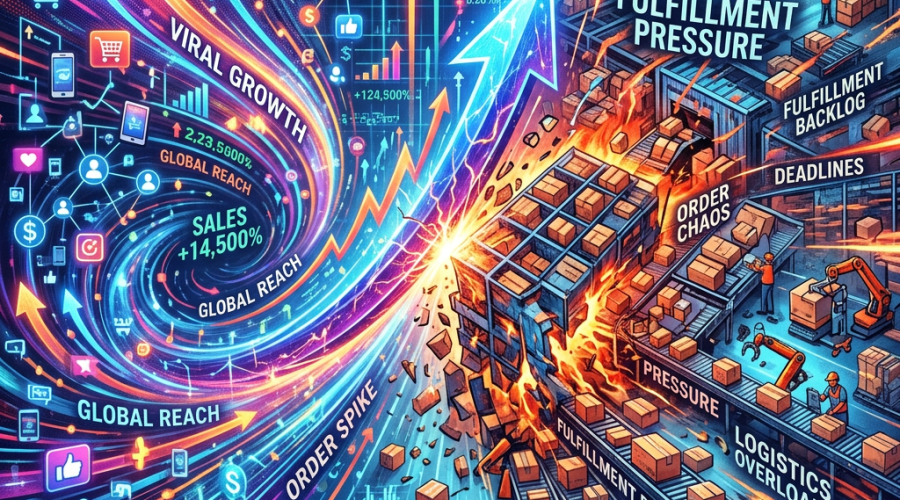
Growth creates pressure.
More orders create more complexity.
Consequently, fulfilment systems need to evolve alongside the business.
One common mistake is assuming fulfilment can remain unchanged as order volume
increases.
In reality, fulfilment capabilities often determine how quickly a business can scale.
Strong fulfilment supports growth.
Weak fulfilment limits it.
Why Fulfilment Is Becoming More Strategic
Historically, fulfilment was viewed as a backend operation.
Today, many ecommerce brands see it differently.
Fast delivery.
Reliable tracking.
Easy returns.
These are now customer expectations rather than premium features.
As a result, fulfilment increasingly influences:
- conversion rates
- customer retention
- profitability
- brand reputation
Businesses that understand this tend to make more informed operational decisions.
Looking Ahead
The future of order fulfilment will likely involve:
- greater automation
- smarter inventory forecasting
- improved visibility
- more localised fulfilment networks
- faster delivery expectations
While technology continues to evolve, the objective remains unchanged.
Get the right product to the right customer at the right time.
Consistently.
Final Thoughts
Order fulfilment sits at the centre of every successful ecommerce operation.
Although customers rarely think about fulfilment when everything works, they remember
it immediately when something goes wrong.
For that reason, fulfilment should be viewed as more than a logistics function.
It is a customer experience function.
It is a profitability function.
Most importantly, it is a growth function.
Brands that invest time understanding their order fulfilment process are often better
positioned to scale efficiently and deliver consistently strong customer experiences.
FAQs
What is order fulfilment?
Order fulfilment is the process of receiving, processing, packing and delivering
customer orders.
What are the stages of the order fulfilment process?
The main stages include receiving inventory, storage, order processing, picking, packing,
shipping and returns management.
Why is order fulfilment important?
It directly impacts customer satisfaction, repeat purchases, operational costs and
business growth.
Can order fulfilment be outsourced?
Yes. Many ecommerce businesses use third-party logistics providers to manage
fulfilment operations.
What causes fulfilment delays?
Common causes include inventory inaccuracies, carrier issues, picking errors and poor
operational processes.


Comments
Share a question or insight about this article.