
Returns Policy for an Online Store: What It Costs
Every line in your returns policy has a handling cost. See the UK legal minimum, what a 3PL does with each return and how to set a policy you can afford.
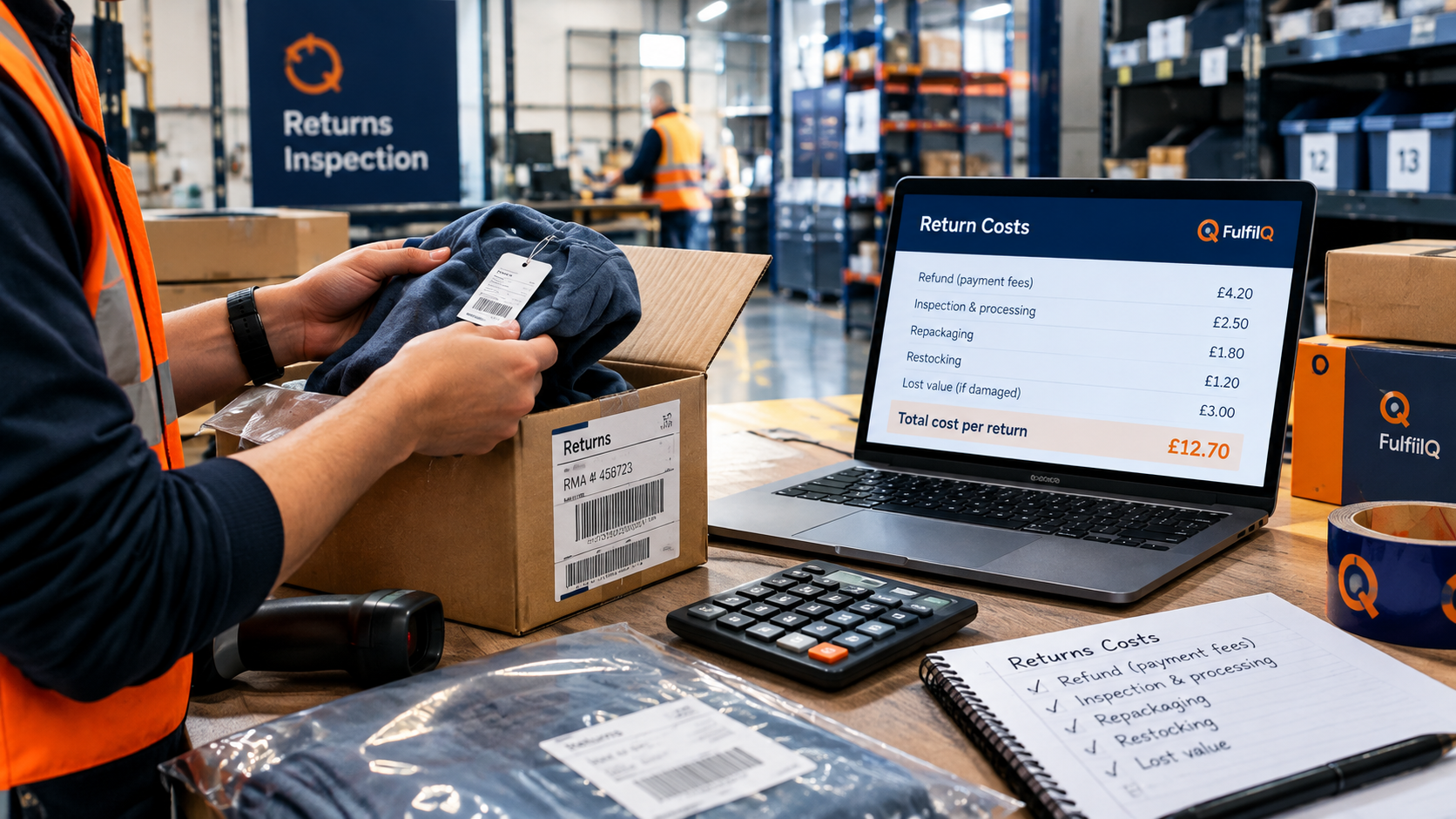
The returns policy on your website is a list of promises, and your 3PL charges for keeping each one. A longer window ties up stock for longer. Free returns mean you pay for the label. A detailed inspection process means someone is paid to grade every item. Most founders copy a policy from a competitor and see the cost when the invoice arrives.
This guide starts with what the law requires, follows a return through the warehouse, and shows what each part of your policy costs, so you can set a policy that protects your margin.
The pain points
Return rates climb in categories like clothing and footwear, and each return costs real money.
Stock comes back too late to resell at full price.
Parcels arrive unlabelled and unannounced, so matching and grading slow down.
Refunds go out before you know whether the item was resellable.
The UK legal minimum
For goods bought online, distance selling rules give customers a 14 day cancellation period. It starts when they place the order and ends 14 days after they receive the goods. After they tell you they are cancelling, they have a further 14 days to send the goods back. You then have 14 days to refund, counted from when you receive the goods back or when the customer shows proof they sent them, whichever comes first.
You must tell customers before they buy who pays the cost of returning items. Faulty goods are covered by separate consumer rights, and the customer should pay nothing to send back something that is not as described or does not work. Some goods have exceptions, such as sealed hygiene items once opened and made-to-order products. Check the government's guidance or take advice for your own range.
Anything beyond that, such as 30 or 60 day windows, free returns and exchanges, is your choice. Each is a marketing decision with an operations cost.
What happens to a return inside a warehouse
Receive. The parcel arrives, is matched to a return authorisation and scanned.
Inspect and grade. Someone opens it, checks the item and decides whether it can be resold, needs repacking or must be discarded.
Restock or dispose. Sellable items go back on a shelf and into your available stock. Others are quarantined, donated, recycled or binned.
Report. You receive the result so you can refund the customer.
Providers usually charge per return for steps one to three, and sometimes for storage of stock waiting to be graded. Rates differ widely, so ask for them in writing. Our guide to how ecommerce fulfilment works shows where returns fit in the wider process.
Policy lines and the costs they create
Free returns. You pay the return label and the carrier. Return postage is often cheaper through a pre-agreed service than through the customer's own choice.
A long return window (30 days or more). Stock is out of circulation for longer, and seasonal items may come back too late to sell at full price.
Full refund for any reason. The warehouse cost per return stays the same, and the return rate rises in categories like clothing and footwear.
Exchanges. Each one is a return plus a new outbound order, and you pay for both.
Unopened items or tags attached only. Grading is faster and more stock is resellable, with more customer complaints for your team to handle.
Returns accepted from any address. Parcels arrive unlabelled and unannounced, which slows down matching and grading.
Fast refunds on tracking scan. Customers like it, and you carry the risk if the parcel never arrives or comes back damaged.
How to work out your cost per return
Add the return postage you pay.
Add your 3PL's receiving, inspection and restocking charges.
Add the cost of any item that cannot be resold, spread across all returns.
Add your customer service time and any payment fees you do not get back.
Divide by the number of returns in a month.
Then multiply by your return rate. A cost of £6 per return is a small number at a 3 percent return rate and a large one at 25 percent. Our guide to hidden fulfilment costs lists other charges that show up late.
Our recommendations for a policy you can afford
Start with your return rate. If you do not know it, pull 12 months of orders and returns and calculate it by product.
Charge where it makes sense. A flat return fee, or free exchanges with paid refunds, steers customers toward keeping the product.
Use a returns portal or a label in the box. Authorised returns arrive labelled and are easier to process.
Match the window to the product. A seasonal item needs a shorter window than a 60 day policy.
Fix the cause. Size guides, better photos and honest descriptions cut returns more than any policy wording.
Write the policy down with your 3PL. They should know your grading rules, so a return gets restocked or binned by agreed rules and never by guesswork.
What waiting costs
Returns cost you on every order that comes back, all year. At a 10 percent return rate and £6 per return, a brand shipping 1,000 orders a month spends about £600 a month on returns handling alone. Those figures are an example, and your own are on your invoices. A policy change takes effect for new orders the day it goes live, so the sooner you set it from real numbers, the sooner the saving starts. Make the change before your next peak, when return volumes climb.
Questions to ask your 3PL about returns
What do you charge to receive, inspect and restock a return?
How quickly after arrival is a return graded and reported to me?
What happens to items that cannot be resold?
Can you offer a returns portal or prepaid labels?
Do you charge to store returns waiting for a decision?
The 20 questions to ask a 3PL includes the return questions alongside pricing, accuracy and contract terms.
People Also Ask
What must a UK online returns policy include?
It must respect the 14 day cancellation right for distance sales, tell customers who pays for return postage before they buy, and leave their rights on faulty goods intact. Check government guidance for exceptions that apply to your products.
How much does it cost an online store to process a return?
It varies by provider and product. Add the return postage, the 3PL's receiving and inspection charge, the value of items that cannot be resold and your support time, then divide by the number of returns.
Should an online store offer free returns?
It depends on your margin and return rate. Free returns can lift conversion, and you pay for every label. Work out your cost per return and your return rate first, then test a charge or a free exchange option.
Finding the right 3PL partner
FulfilQ's advisor, Logan, matches brands to verified providers by order volume, product type and region. Tell Logan what you ship and how you handle returns, and you get a shortlist of providers that can do it. Start at fulfilq.com or browse the full provider directory.

Comments
Share a question or insight about this article.