
Do You Need GS1 Barcodes Before You Use a 3PL?
Not sure if you need GS1 barcodes before moving to a 3PL? Learn what a GTIN is, when a warehouse needs one and when your own SKU labels are enough.
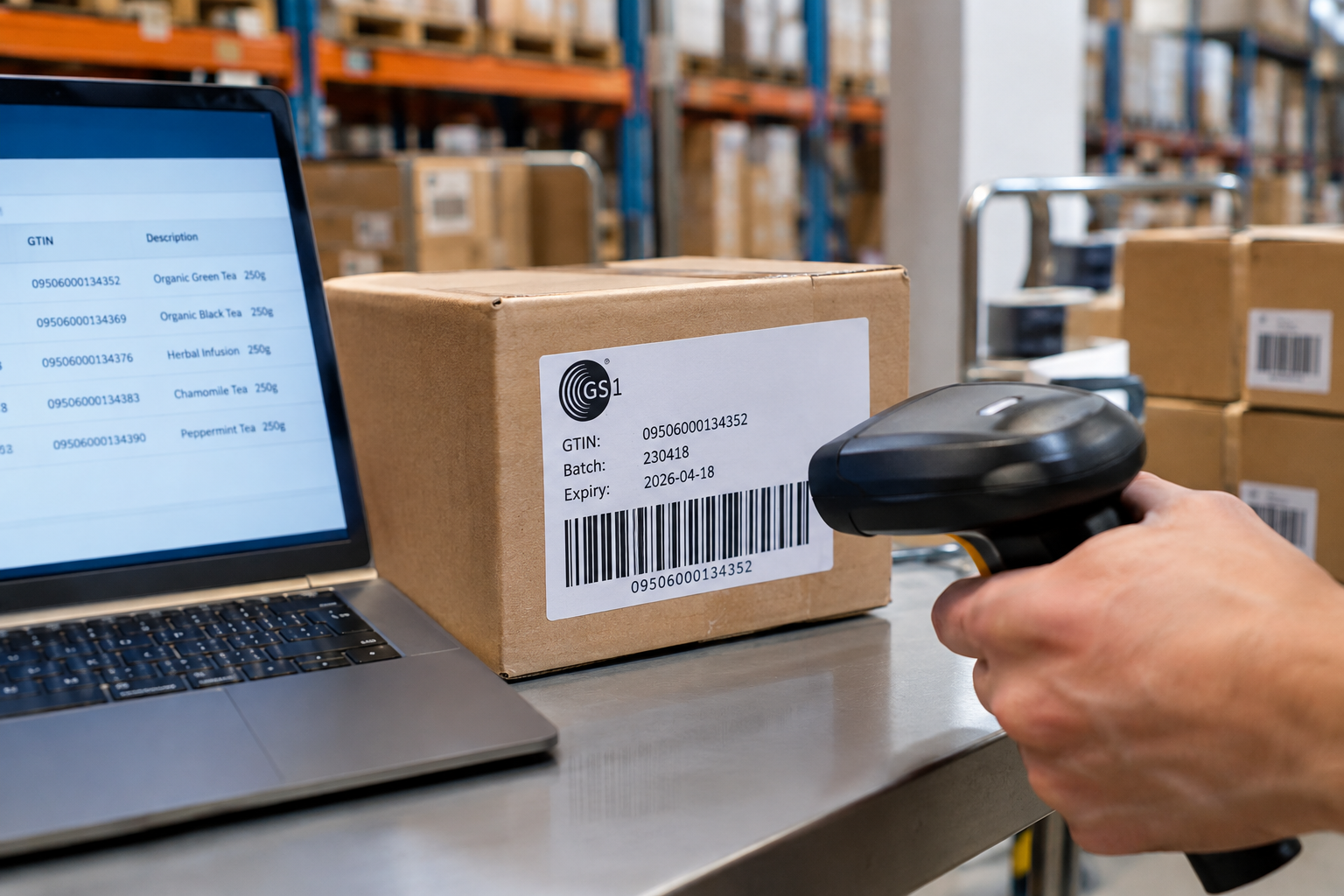
You do not always need GS1 barcodes to use a 3PL. A warehouse can run on barcodes you make yourself, as long as every product has a unique, scannable code that stays the same. You do need GS1 barcodes if you sell through major retailers or marketplaces, or if you want one code that works for you, your warehouse and every sales channel. Many brands find out the hard way, when homemade SKU labels meet a warehouse scanner or a retailer's listing form.
This guide explains what each type of barcode does, when you need which, and how to get your products ready before the first delivery arrives.
Two different things: a SKU and a GTIN
A SKU is your own internal code for a product and its variants, such as MUG-BLUE-L. You invent it. It means something only inside your business.
A GTIN is a global trade item number, the number behind the barcode on retail products. In the UK and Europe it is usually 13 digits, often called an EAN. It identifies one product, anywhere in the world.
A warehouse needs to scan something to know what it is holding. That something can be a barcode that carries your SKU, or a GTIN. Both work inside the building. Only a GTIN works outside it.
What GS1 is
GS1 is the organisation that issues GTINs. In the UK you join GS1 UK, receive a company prefix and then create a number for each product. It is a membership with an annual fee, not a one-off purchase, and the cost depends on your size and how many products you list. Check current pricing on the GS1 UK website.
Barcodes sold by resellers can look cheaper. Some are linked to the reseller's company prefix, not yours, and some marketplaces and retailers do not accept them. Check a retailer's rules before you buy numbers from anyone other than GS1.
When you need GS1 barcodes
You sell to retailers. Most expect a GTIN on every product and on every outer carton.
You sell on marketplaces such as Amazon. They ask for a product identifier when you list, and they have their own rules on where it comes from. Check the current requirements for your category.
You want one code across everything. A GTIN lets you, your supplier, your 3PL and your retailers all identify a product the same way.
Your products are sold in shops. Tills scan the retail barcode on the pack.
When your own labels are enough
If you only sell on your own website and ship every order from a warehouse, internal barcodes can do the job. Your 3PL scans a code, the system recognises the SKU and the pick is confirmed. Many providers will print and apply labels for you at receiving, usually for a fee per unit. Ask for the rate in writing.
The risk is rework. If you later start selling to a retailer or marketplace, you will need GTINs, and every unit already in the warehouse may need to be relabelled. Think about where you will be in 12 months, not just today.
What a good barcode setup looks like
One unique code per variant. A blue large and a blue medium are different products and need different codes.
Codes that never change. Reusing a code for a new product causes stock errors that are hard to trace.
The same code on the product, the carton and in your data file.
Labels that print cleanly and scan on the first pass: good contrast, no curved surfaces, no covering with shrink wrap.
Outer cartons labelled with the product code and the number of units inside.
What your 3PL will ask for
During onboarding, expect a product file with SKU, name, barcode, weight and dimensions for every item. Our guide to the first 30 days with a new 3PL shows where this fits. Messy barcode data is one of the most common causes of delay.
Does every product have a unique barcode?
Are any barcodes duplicated across variants?
Do the codes in your file match what is printed on the products?
Who applies the labels, and what does it cost per unit?
Ask the provider these as well when you compare. Our 20 questions to ask a 3PL covers the pricing and systems questions that sit alongside them.
A simple plan before you move
List every product and variant in one sheet.
Decide whether you need GTINs now or within a year.
If yes, join GS1 UK and create codes before you reorder stock, so new production arrives labelled.
If no, create clean internal codes and agree who labels them.
Test: scan five products with a phone or a cheap scanner and check each one returns the right item.
People Also Ask
Do I need a barcode to use a 3PL?
You need some scannable code on every product. It can be an internal barcode carrying your SKU. A GS1 barcode is only required if you also sell through retailers or marketplaces that ask for one.
What is the difference between a SKU and a barcode?
A SKU is your own internal product code. A barcode is a machine-readable way to show a code. A GTIN is a standard product number from GS1 that works across businesses and retailers.
Can a 3PL label my products for me?
Many can, usually as a paid service per unit at receiving. Ask for the rate and the turnaround before you agree, and check that the labels will scan.
Finding the right 3PL partner
FulfilQ's advisor, Logan, matches brands to verified providers by order volume, product type and region. Tell Logan what you ship and where it goes, and you get a shortlist you can ask about labelling and inbound requirements. Start at fulfilq.com or browse the full provider directory.


Comments
Share a question or insight about this article.