
Language, labelling and instructions: what each EU country requires on products
Pick one product off your shelf and check it against eight questions. If it fails any of them, every country you sell into has the same problem.
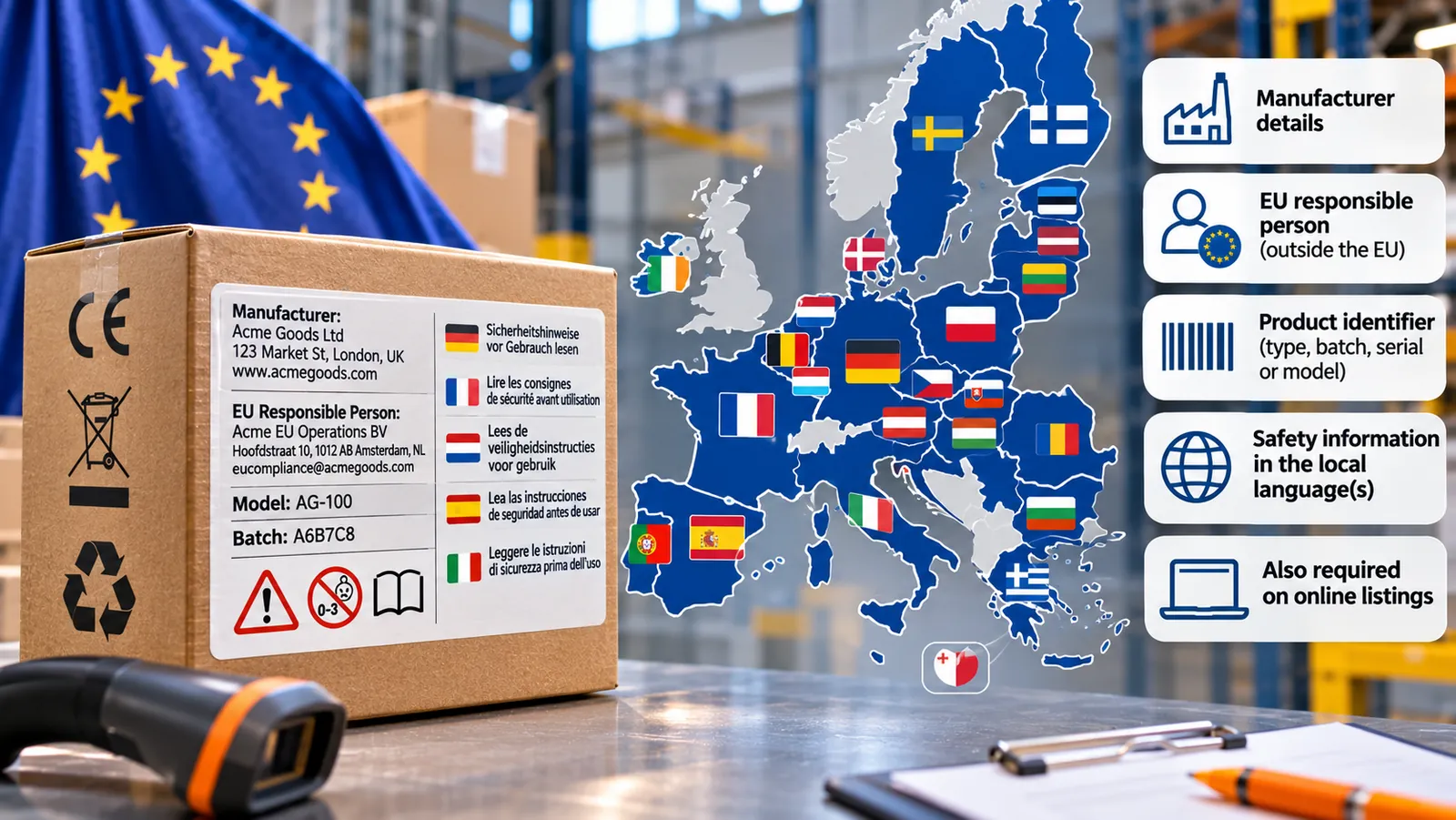
Products sold to EU consumers must carry the maker's name and contact details, a product identifier, and safety warnings and instructions in a language consumers in each country can understand, which usually means that country's official language. Since 13 December 2024, the General Product Safety Regulation (GPSR) has also required an EU-based responsible person for goods made outside the EU, named on the product, its packaging or an accompanying document.
For a UK or US brand expanding into Europe, labelling is where launches quietly stall. Stock arrives at an EU warehouse with English-only warnings and no EU contact, a marketplace blocks the listing, or a market surveillance check holds a pallet. Every fix costs more once the goods are in Europe, so the cheapest time to sort labels is before the factory prints the next run.
Last checked: 20 November 2026, against the European Commission's GPSR guidance for businesses. Sector rules for cosmetics, toys, textiles, electricals and food add their own labelling requirements. General information, not legal advice.
What the GPSR asks every product to show
Start with the manufacturer. The label needs the manufacturer's name or registered trade mark, a postal address and an electronic contact such as a website or email address. It goes on the product where that's possible, and on the packaging or an accompanying document where the product is too small or the surface won't take it.
Next is the EU responsible person. A brand based in the UK, the US or anywhere else outside the EU needs an economic operator established in the EU to take responsibility for the product. That can be an importer, an authorised representative appointed in writing, or a fulfilment service provider acting in that role. Their name and contact details sit on the product, packaging or accompanying document, alongside the manufacturer's.
Then the identifier. A type, batch, serial or model number has to be easy to see and read, so that a recall notice can be matched to the units in a customer's home. Finally, warnings and safety information must appear in a language consumers can easily understand, as decided by each country where the product is sold. Your brand name and marketing copy can stay in English. Warnings, instructions for safe use, disposal guidance and age guidance need translating.
Which languages each country expects
Most EU countries expect their own official language on safety information, and a few cases catch brands out. France requires French for consumer information and enforces it actively. Belgium has three official languages, so most brands label in French and Dutch and add German if they sell into the German-speaking east. Luxembourg accepts French or German for most products. Ireland and Malta accept English. Finland generally expects both Finnish and Swedish.
For a brand starting in Germany, France and the Netherlands, that means three languages on the safety text from day one. Many brands design one multilingual panel that covers their first five or six markets, then add languages as they expand. A panel built around a short set of warnings, with pictograms where the sector allows them, keeps the space needed manageable even at six languages.
Plan the order of expansion with the panel in mind. Adding Spain and Italy later is simple if the panel was designed with room for two more languages. Squeezing them onto a box designed for three usually means a new print run.
Sector rules that sit on top
The GPSR is the floor, and several sectors add their own requirements. Textiles must show fibre composition in the official language of the country of sale. Cosmetics must carry specific information, including precautions and the product's function where it isn't obvious, in the language required by each country. Toys carry their own age and safety warnings. Electricals carry the CE mark and the crossed-out bin symbol for WEEE, and batteries carry their own marks and collection symbol.
If you sell in one of these sectors, check the sector rule before designing the panel, because it often decides how much space the label needs.
Online listings count too
The GPSR applies to the listing as well as the product. When you sell at a distance, through your own site or a marketplace, the listing must show the manufacturer's details, the EU responsible person, a picture and identifier of the product, and any warnings or safety information, before the customer buys.
Marketplaces now ask sellers for this information when a listing is created and can block or remove listings without it. A brand that has the label right and the listing wrong still loses the sale, so update both at the same time.
Stickers, inserts or a reprint
There are three ways to get compliant labels onto stock, and most brands use more than one as they grow. A durable sticker applied over or beside the existing label is the fastest. It works for the responsible person's details and for translated warnings, as long as it stays legible and attached through handling. An insert in each box suits longer instructions, though a loose paper insert that falls out of the parcel doesn't count as information that reached the consumer, so anything safety-critical belongs on the pack itself.
A reprint at the factory is the cheapest per unit once volumes are steady. Many brands sticker their first EU shipments, learn which markets sell, and then move to a multilingual print run for the next production order.
The one-product audit
Take your best-selling product, as it would arrive at an EU customer's door, and check it against these eight questions.
Does it show the manufacturer's name, postal address and an electronic contact?
If you're outside the EU, does it name an EU responsible person with their contact details?
Does it carry a type, batch, serial or model number that's easy to read?
Are the warnings in the language of every country you sell into?
Are the instructions for safe use, assembly, care and disposal in those languages, where they matter for safety?
Does your sector add anything, such as fibre composition, cosmetics information or toy warnings?
Does your online listing show the manufacturer, responsible person, identifier and warnings?
Would the safety information survive a parcel journey, printed on the pack or securely attached?
If the product fails any question, the same fix usually applies across your range, so work through the answers once and apply them to every product line.
Setting up relabelling with your 3PL
If your stock arrives without the right labels, an EU 3PL can apply them before it goes on the shelf. Ask for a per-unit price, how many days it adds to receiving, and whether it can label by destination country at the point of picking, which saves labelling stock for markets it may never ship to. Ask too whether the provider can act as your EU responsible person, what that role covers, and what it costs each year.
Our guide to GPSR for UK brands selling into the EU covers the responsible person role in more depth. When you are comparing warehouses, you can browse European 3PLs and ask each one for its relabelling price before you ship.
Need a logistics partner?
Tell Logan what you ship and where, and get a shortlist of partners that fit.
Submit an RFP

Comments
Share a question or insight about this article.