
What shapes a realistic 3PL onboarding timeline
A 3PL onboarding timeline is rarely determined by how quickly a provider can issue a quote. It is determined by the work needed to make your orders, stock, customer promises and operating rules function correctly inside a new warehouse.
A brand shipping 2,000 straightforward DTC orders a month may launch in four to six weeks. A multichannel business with retailer routing guides, batch-controlled stock, returns grading and multiple sales channels may need 10 to 16 weeks.
That difference matters. Rushing a launch can create stock discrepancies, unshipped marketplace orders, incorrect carrier services or returns that disappear into an unstructured process. Taking longer than necessary has a cost too: duplicate warehouse fees, internal distraction and delayed capacity relief. The right plan is not the fastest one. It is the shortest timeline that still gives both sides time to test the operation properly.
The first variable is operational complexity. Order volume matters, but it is not the whole story. A 20,000-order-per-month brand with a small SKU range and one ecommerce storefront may be simpler to onboard than a 2,000-order business selling across Shopify, Amazon, TikTok Shop, wholesale and two retailer portals with 1,000+ SKU's.
Product characteristics also change the plan. Fragile items, expiry-dated goods, regulated products, subscriptions, kitting, personalisation, serial numbers and batch tracking all require warehouse rules that cannot be assumed. If a provider has never handled your product category or compliance requirements, the timeline needs to account for process design and staff training, not just a system connection.
Then there is the state of your own data. Clean SKU master data, accurate dimensions and weights, agreed carton configurations, current inventory records and documented order rules will move onboarding forward. Missing or conflicting information will not necessarily stop a project, but it will surface later as exceptions. Those exceptions are usually more expensive to solve after stock has arrived.
Capacity is another practical constraint. A 3PL may have the physical space for your stock but lack receiving slots, implementation resource or trained labour during a peak period. Ask about all three. An available pallet location is not the same as an available onboarding window.
A typical 3PL onboarding timeline
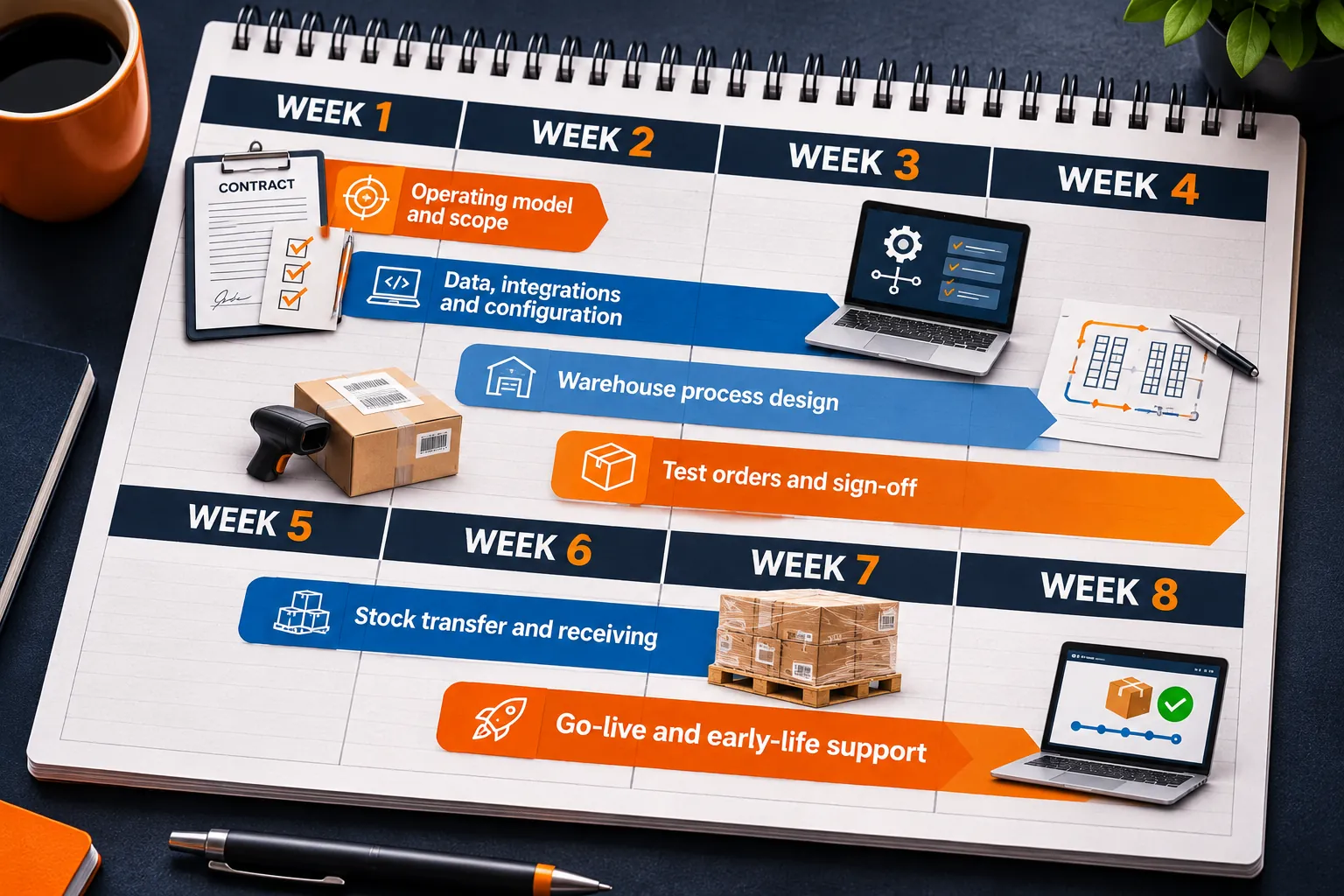
Week 1: Confirm the operating model
The project should begin with a detailed discovery session, not a generic welcome call. Both parties need to agree what is being launched, where it will ship, and what good performance looks like from day one.
This is where the provider should capture monthly and peak order volumes, SKU count, inbound profile, storage requirements, sales channels, delivery regions, cut-off times, returns rules and value-added services. It should also document non-standard requirements: retailer routing guides, marketplace labelling, gift notes, temperature controls, lot control or two-coast inventory splits.
The output should be a written scope, ownership map and launch plan. If commercial terms are still vague at this stage, resolve them before technical work begins. For example, clarify whether kitting is included, how storage is charged during the transition, and what happens if inbound stock arrives outside booked appointments.
Weeks 1-3: Data, integrations and configuration
Most onboarding delays sit here. The 3PL’s warehouse management system needs clean information about your products and orders, while your ecommerce platforms and marketplaces need correct inventory and dispatch updates in return.
The basic integration may be available through a connector, but the operational detail still needs configuring. Map which status triggers dispatch confirmation, how cancellations are handled, whether partial shipments are permitted, which carrier service applies to each destination, and how returns are recorded. If your brand uses an ERP, order management system or bespoke middleware, allow additional time for technical testing and exception handling.
Your SKU file deserves particular attention. Each product should have a unique identifier, accurate dimensions and weight, barcode information, replenishment unit, country of origin where relevant, and handling instructions. If a single product is sold as an individual unit, a bundle and a wholesale case, make those relationships explicit. Warehouses cannot reliably infer commercial logic from product names.
Weeks 2-4: Warehouse process design
Technology tells the warehouse what to do. Process design tells people how to do it consistently.
During this phase, agree the receiving process, putaway rules, pick method, packaging specifications, carrier allocation, order cut-offs, quality checks and returns flow. For brands with wholesale, the provider should also validate retailer-specific labels, ASN requirements, carton labelling and routing-guide rules before the first order is released.
A useful conversation is to work through the exceptions rather than just the happy path. What happens when a customer changes an address after an order is released? What happens when an item is damaged in pick? Who approves a substitute packaging format if your preferred box is unavailable? What happens to a return with no order reference? These decisions prevent teams from improvising under pressure.
Weeks 3-5: Test orders and sign-off
Do not treat testing as a box-ticking exercise. Place orders that reflect the real mix of demand: single-line orders, multi-line orders, bundles, priority services, remote postcodes, international shipments and returns. If wholesale is in scope, test a retailer order from receipt through to compliant paperwork and carrier collection.
Review the result against agreed acceptance criteria. At a minimum, both teams should confirm that:
inventory quantities reconcile between source systems and the warehouse;
orders flow into the warehouse without manual intervention or duplication;
shipping labels, tracking notifications and carrier services are correct;
pick, pack and dispatch performance meets the agreed rules; and
returns and customer-service queries have a defined route.
This phase often reveals minor issues. A missing product weight can affect carrier charges. A bundle may split incorrectly. A tracking status may not reach the ecommerce platform. These are exactly the issues testing is meant to expose. A provider that flags them early is doing the work properly, not slowing the project down.
Weeks 4-6: Stock transfer and receiving
Stock migration is where planning becomes physical. Agree the inventory cut-off, final dispatch date at the outgoing warehouse, transport booking, receiving appointments, pallet and carton labels, and the reconciliation method. Avoid sending stock with only a broad spreadsheet and expecting the warehouse to work it out on arrival.
Your inbound file should match the physical shipment: SKU, quantity, batch or expiry information where applicable, and packaging hierarchy. If the new 3PL is receiving thousands of mixed cartons, permit time for count checks and discrepancy investigation. The stock is not truly live simply because the lorry has reached the loading bay.
For a low-risk transition, some brands run a short overlap. The incumbent fulfils orders until a defined cut-off while the new provider receives stock and validates inventory. This can reduce customer disruption, but it also adds cost and requires strict rules to avoid selling the same stock from two locations.
Weeks 6-8: Go-live and early-life support
Go-live should be controlled, not ceremonial. Many brands start with a limited channel, region or order volume before moving to full fulfilment. That is particularly sensible when launching a new integration, a new carrier mix or a warehouse operation during a high-demand period.
For the first one to two weeks, set a daily operational review. Look at order backlog, inventory variances, mis-picks, carrier collection performance, delivery exceptions, customer contacts and returns. Make sure there is a named escalation route on both sides. A weekly account-management call is useful later; it is usually too slow for the first days of a launch.
When a faster launch is realistic
A three-week launch can be achievable when the operation is simple: one sales channel, standard products, clean data, a proven integration, no special handling and stock that can be received in clearly labelled pallets. It also depends on the 3PL having immediate implementation capacity.
Be cautious of a provider promising that same speed for a business with several marketplaces, complex B2B requirements or products needing batch control. The cheapest quote means very little if the operation behind it cannot support where your business is going.
How to keep the project moving
The brand’s contribution is often the limiting factor. Assign one internal project owner with authority to make decisions, rather than spreading approvals across ecommerce, finance, operations and customer service. Give the 3PL one current source of truth for products, packaging, order rules and contacts.
It also helps to distinguish launch-critical requirements from improvements that can follow. A new branded insert, an advanced reporting dashboard or a less common carrier service may be valuable, but not every enhancement needs to hold up a safe go-live. The exception is anything that affects compliance, customer promises or revenue recognition. Those belong in the initial scope.
When comparing providers, ask each one to explain its onboarding plan against your actual operation. A credible answer includes likely lead times, dependencies, capacity watch points and the people responsible. Platforms such as FulfilQ can help brands assess those operational-fit questions before a provider is selected, rather than discovering them halfway through implementation.
A good launch does not feel dramatic. Orders leave on time, stock figures make sense, customer-service teams know where to send exceptions, and the warehouse has rules it can follow under pressure. Build your timeline around that outcome, and treat every extra week as a decision about risk, not a failure of pace.




Comments
Share a question or insight about this article.