
GST on low-value imported goods: what overseas brands selling to Australia must do
Selling from the UK, the US or the EU into Australia? Whether you charge GST comes down to five questions. Work through them in this order.
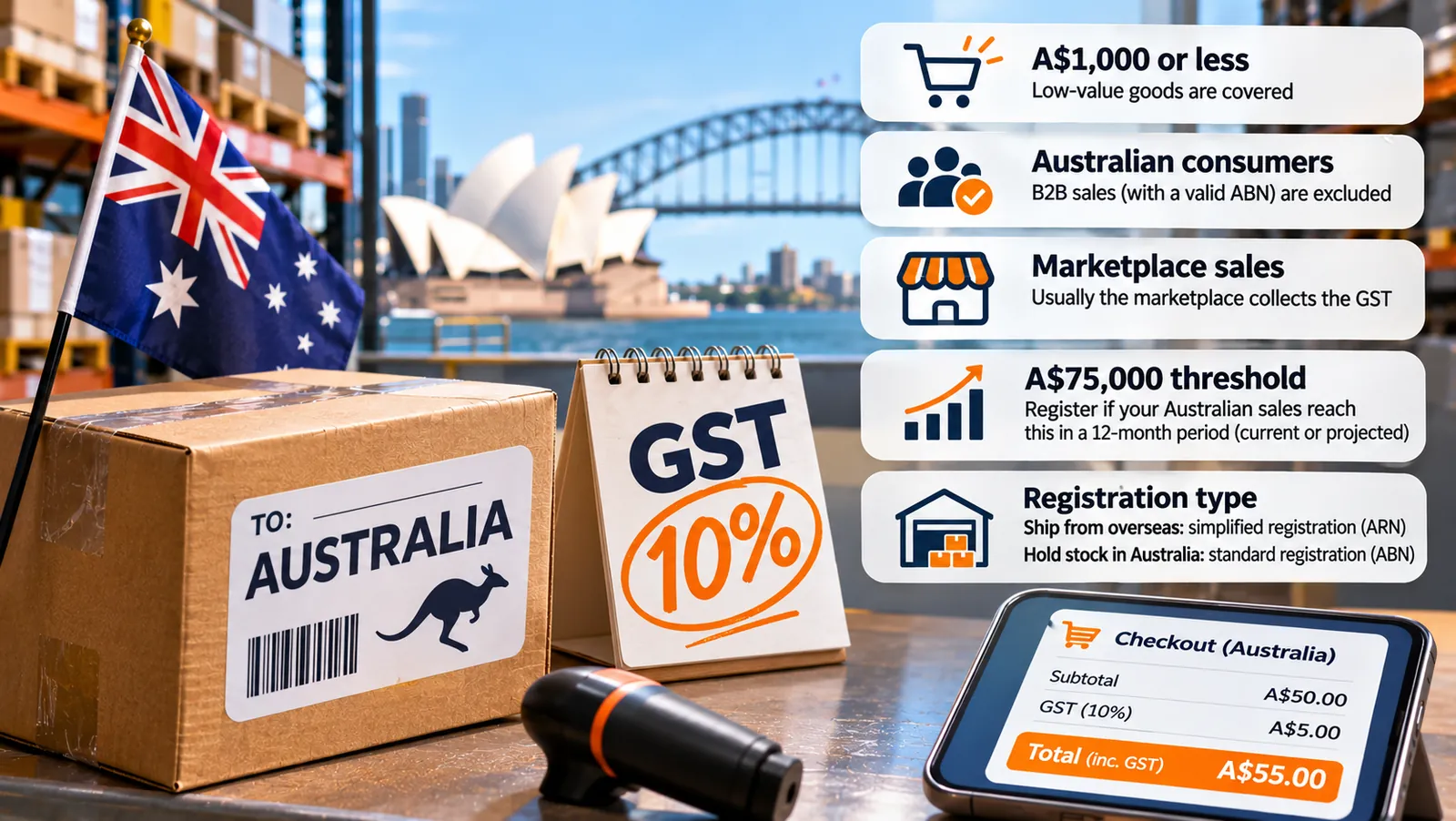
If you sell goods worth A$1,000 or less to Australian consumers and your sales connected with Australia reach A$75,000 a year, you must register for GST and charge 10% at checkout. Sales made through an online marketplace are usually handled by the marketplace. Stock you hold in Australia is taxed at import under the normal rules.
Since July 2018, Australia has collected GST on low-value parcels at the point of sale, not at the border. For an overseas brand, that moves the work from the customer's doorstep to your checkout, your tax filings and the labels on your parcels. Five questions settle where you stand. Answer them in order, then use the checklist at the end.
Last checked: 16 November 2026, against the ATO's guidance for non-resident businesses, simplified GST registration and marketplace operators, and Home Affairs Notice 2018/13. General information, not tax advice. Confirm your position with a tax adviser.
Question 1: Are the goods worth A$1,000 or less?
The low-value rule covers goods with a customs value of A$1,000 or less, judged when the price is first agreed with the customer. Tobacco and alcohol are excluded and follow their own rules.
Goods above A$1,000 go through a formal import declaration, and GST is paid at the border along with any duty. If most of your orders are high-value furniture or electronics, this article mostly doesn't apply to you. Your customs broker and importer of record matter more.
Question 2: Is the buyer a consumer?
Sales to Australian businesses registered for GST fall outside the rule and don't count towards your threshold. The business accounts for the GST itself.
To treat a sale as business-to-business, collect the customer's ABN and a statement that they are registered for GST, and check the ABN on ABN Lookup. Build this into checkout as an optional field for trade buyers, and keep the record with the order.
Question 3: Do you sell through a marketplace?
The ATO calls marketplaces electronic distribution platforms. A platform registered for GST is generally responsible for GST on low-value goods sold through it to consumers. In that case you don't return GST on those sales, and they don't count towards your own threshold.
The responsibility moves back to you only when three things are true together:
The customer's document names you as the supplier, not the platform.
You and the platform have agreed in writing that you pay the GST.
The platform doesn't control the sale. It doesn't authorise the charge, doesn't authorise delivery, and doesn't set the terms.
For most brands selling on large marketplaces, the platform collects. Sales from your own website are always your responsibility.
Question 4: Will your Australian sales reach A$75,000?
The threshold counts your own-site sales of low-value goods to consumers, plus any digital products and imported services you sell to Australia. Test it two ways:
Current: this month plus the previous 11.
Projected: this month plus the next 11.
If either reaches A$75,000, you must register. You can also register voluntarily below the threshold, and you should then stay registered for at least 12 months.
A made-up example: a UK skincare brand sells about A$5,000 a month to Australian consumers through its own Shopify store, and plans an Australian launch that should add A$2,000 a month from January. Its last 12 months come to about A$60,000, under the threshold. Its next 12 months project to A$78,000, over it. It must register now, before the launch, without waiting to see the sales.
Question 5: Do you hold stock in Australia?
Your answer decides which registration you use.
Shipping each order from overseas: simplified GST registration.
You get an ATO reference number (ARN). No ABN needed, and no proof of identity.
You lodge and pay quarterly, online, by SWIFT transfer or card.
You can't claim GST credits, and you can't issue tax invoices.
The ATO says Digital ID will be needed for its online services for non-residents from early 2027, so set that up early.
Holding stock in an Australian warehouse: standard registration. Simplified registration isn't available once you import goods and store them in Australia before selling them online. You register with an ABN, pay GST when the stock is imported, charge GST on your local sales, and claim back the import GST as a credit.
Many brands start on simplified registration, shipping from a UK or US warehouse, then switch to standard registration when they move stock into an Australian 3PL. Plan the switch with your adviser, because you can't hold an ABN and an ARN at the same time.
What changes at checkout
Once registered, charge 10% GST on low-value orders to Australian consumers. Australian shoppers expect one total price that already includes GST, so show prices that way for Australian visitors and don't add tax at the last step.
On a A$55 order with GST included, the GST is one-eleventh, A$5. Set your Australian prices with that in mind. A brand that converts a UK price and then adds 10% on top often ends up priced above local competitors.
What changes on your parcels
This is the step brands miss. Home Affairs Notice 2018/13 asks for a vendor ID, your ARN or ABN, on the customs data for parcels where GST was collected at checkout. It also sets a "PAID" code that can be used on tariff lines where GST has already been paid. The notice says that if GST is charged again at the border, the customer's refund has to come from the seller, not from Home Affairs.
So once you register, give your ARN to your carrier and your 3PL, and check it appears in the customs data on every Australian shipment. A customer charged GST twice will come back to you for the refund.
The checklist
Add up the last 12 months of Australian consumer sales from your own site, and project the next 12, launches included.
Split out marketplace sales, which the platform usually handles.
If either 12-month figure is near A$75,000, register before you cross it: simplified if you ship from overseas, standard if you hold stock in Australia.
Switch your Australian checkout to GST-inclusive prices.
Give your ARN to your carrier and 3PL, and confirm it's in the customs data.
Put the quarterly lodgement dates in your calendar.
Moving stock into Australia changes more than tax. Duty, a customs broker and your choice of 3PL all come into play, and our guide for UK brands expanding to Australia covers them. If you're weighing an Australian warehouse, Ask Logan on fulfilq.com for 3PLs that fit your volume.
Need a logistics partner?
Tell Logan what you ship and where, and get a shortlist of partners that fit.
Submit an RFP



Comments
Share a question or insight about this article.