
Customs warehousing in the EU: deferring duty when you sell across multiple countries
Paying duty on a full container the day it lands ties up cash for months. We follow one example brand through the EU customs warehousing decision.
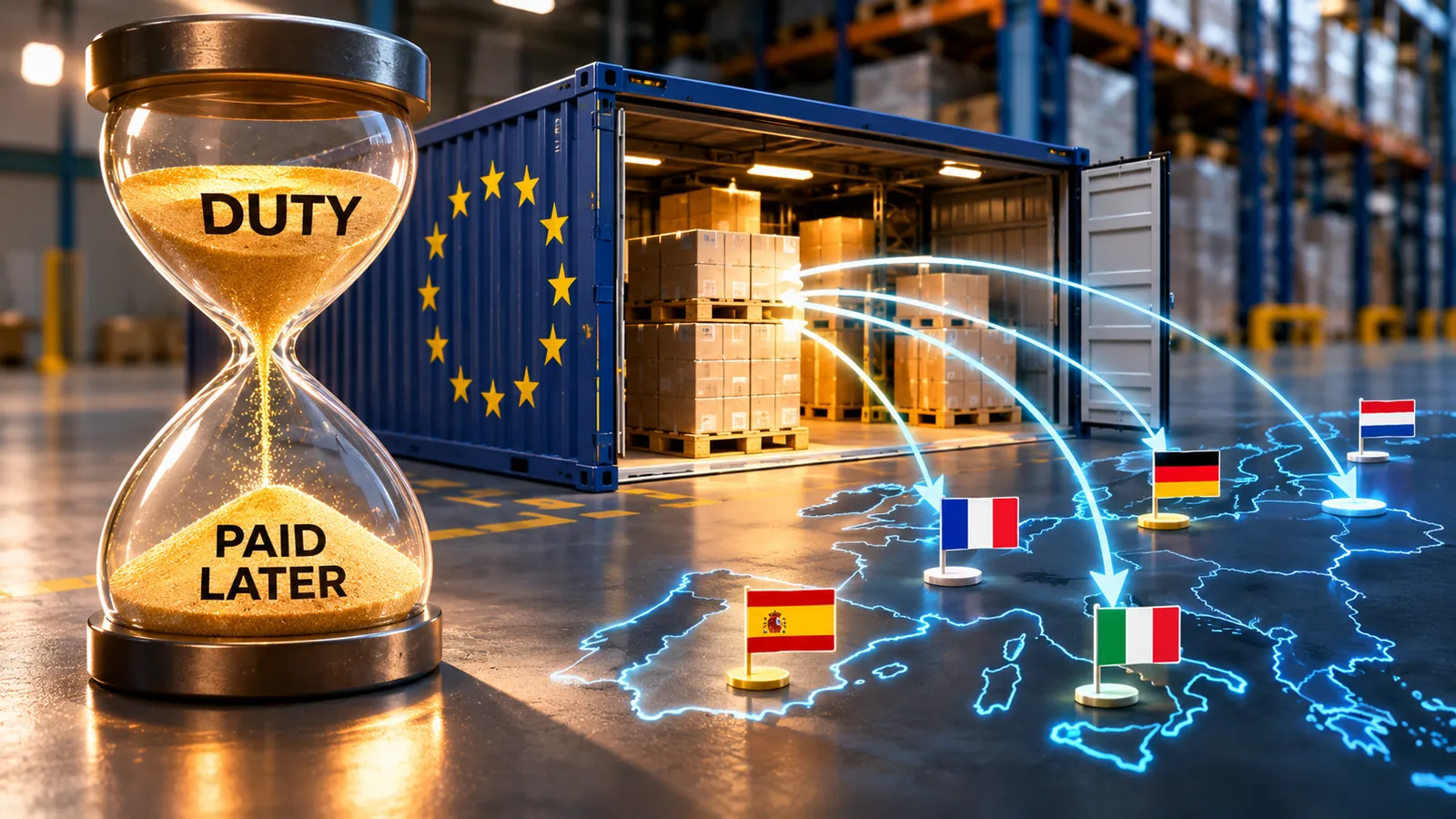
EU customs warehousing lets a non-EU brand store goods in an authorised warehouse with import duty and VAT suspended, and in general with no time limit. You pay as goods leave for sale in the EU. Anything re-exported from the warehouse never pays EU duty at all.
The procedure is easy to describe and harder to judge, so this piece works through one example. The brand and its figures are invented to show the method. The rules are real.
Last checked: 15 November 2026. Authorisations are run by each member state, so confirm the details with the customs authority or a customs representative in the country you plan to use.
The brand
A UK homeware brand sells across the EU from a 3PL in the Netherlands. It imports €400,000 of stock a quarter, made in Asia, at an average duty rate of 12%. Stock takes about four months to sell, and roughly a tenth of it ends up going on to customers in Switzerland and Norway.
Today it clears each container into free circulation on arrival. That means paying €48,000 of duty a quarter up front, plus import VAT, on goods that will sit on shelves for months. Some of that duty is paid on stock that later leaves the EU.
How the procedure works
The European Commission's guidance sets out the essentials:
Non-EU goods sit in premises authorised by customs, under customs supervision.
No import duty or other charges are due while they are stored. Duty and taxes such as VAT fall due when goods are released for free circulation.
In general there is no time limit, except for goods whose nature makes long storage a risk to health or the environment.
Goods leave by release for free circulation, by moving to another customs procedure, or by re-export.
The legal basis is the special procedures chapter of the Union Customs Code.
Warehouses come in two kinds. A public customs warehouse can be used by anyone, and many 3PLs and forwarders run one, so the brand needs no authorisation of its own. A private customs warehouse is for the holder's own goods. The operator must be established in the EU, hold the authorisation and provide a guarantee. For our brand, a 3PL with a public customs warehouse is the realistic option.
Running the numbers
With the stock in a customs warehouse, the brand pays duty as each order ships. With stock turning over every four months, about half the quarter's duty is deferred at any one time, roughly €24,000 of cash it keeps working. The tenth that goes on to Switzerland and Norway leaves without EU duty, saving €4,800 a quarter outright.
Against that, the 3PL charges for:
entering goods into the procedure;
release declarations, usually batched daily;
customs stock records;
a slightly higher storage rate in the secure zone.
Say that comes to €1,500 a month, €4,500 a quarter. The outright saving alone covers it, and the cash-flow benefit comes on top.
When it is the wrong tool
Change the brand's profile and the answer flips. Fast-selling stock that clears in three weeks, with a low duty rate and no sales outside the EU, gains little from deferral, and the customs fees would outweigh it. UK-origin goods that qualify for zero duty under the trade agreement have little duty to defer in the first place. The question is always the same: how much duty and VAT is tied up in unsold stock, and how much leaves the EU.
Choosing the warehouse
When you talk to providers, the useful questions are practical:
How are daily ecommerce orders released, and what does each declaration cost?
Who acts as your customs representative?
Can unsold stock be re-exported, and how?
What handling is allowed inside the customs zone, such as relabelling or repacking?
Our guides to importers of record and landed cost in a 3PL quote cover the rest of the import picture. To find EU providers running public customs warehouses, Submit an RFP with your stock value, duty rates and the share you expect to leave the EU.




Comments
Share a question or insight about this article.