
Poland and the Czech Republic as EU fulfilment hubs: lower costs, central reach
Amazon already serves German shoppers from Polish and Czech warehouses. Here is what the same move looks like for a growing brand: the costs, the VAT setup and the trade-offs.
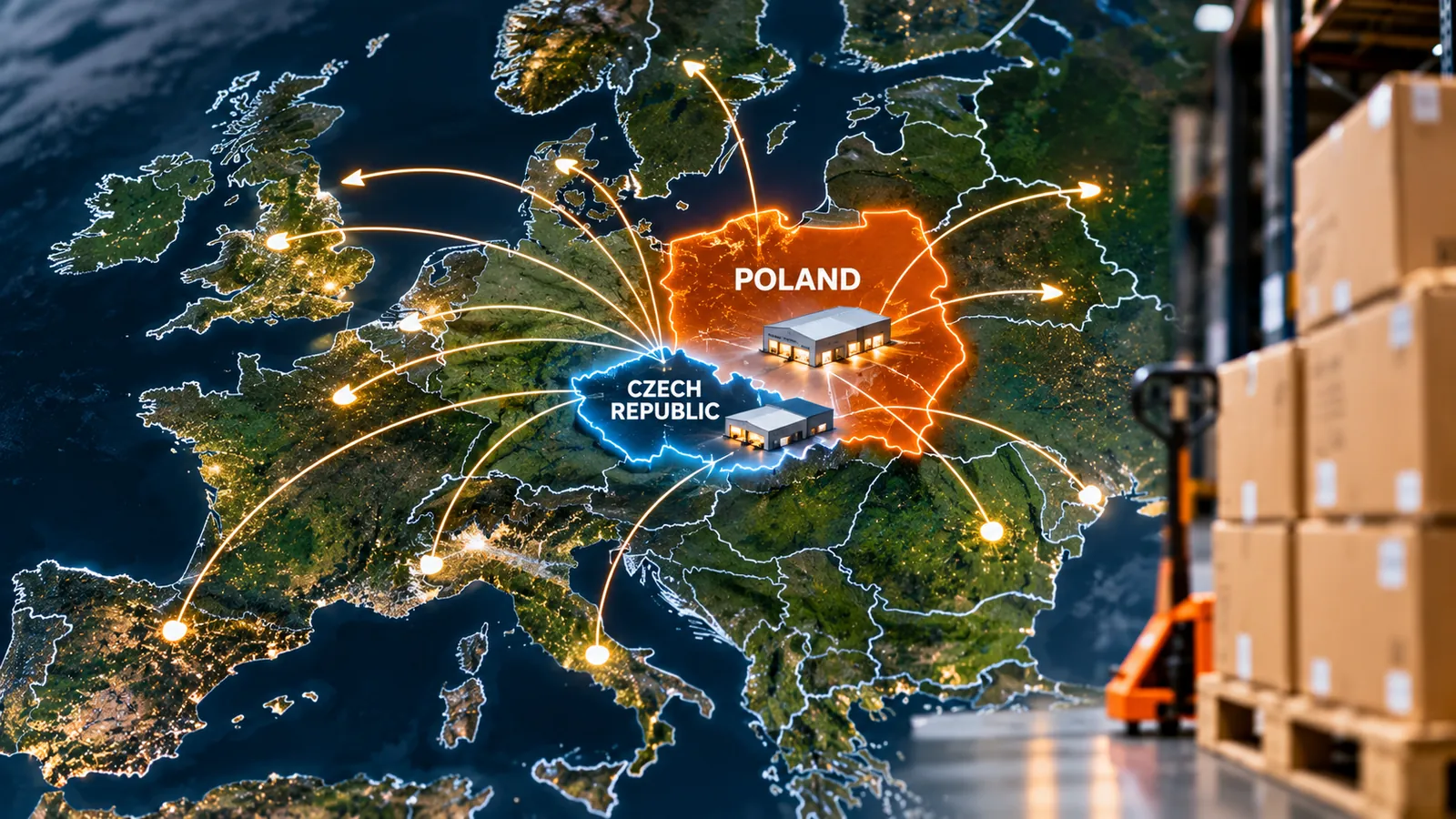
Poland and the Czech Republic are serious options for EU fulfilment. Eurostat puts 2025 hourly labour costs at €19.10 in Poland and €19.80 in Czechia, against €47.90 in the Netherlands, and Polish warehouse rents are among the lowest in Western and Central Europe. Both countries border Germany, the EU's biggest ecommerce market. The Netherlands keeps its edge for brands whose customers are mostly in Benelux, France and the UK.
For years the advice to UK and US brands entering the EU has been the same: find a 3PL in the Netherlands. It's sound advice. Rotterdam is Europe's largest port, Dutch warehouses run in English, and the country has a deep pool of 3PLs used to foreign brands. I'd still put Central Europe on every shortlist, and the clearest reason is that Amazon already does.
Last checked: 16 November 2026. Rents and VAT rules change, so confirm current figures with each provider and a VAT adviser before you commit.
Amazon made the case first
Amazon runs a large network of fulfilment centres in Poland and two in the Czech Republic. Under its Central Europe Programme, sellers' German stock can be held in Polish and Czech sites as well as German ones, and German orders ship from whichever country has the stock. Amazon says sellers save at least €0.26 per unit by taking part, with the same Prime delivery promise as German fulfilment.
Amazon has chosen to serve the German market from across the border, and it pays the price in VAT registrations and cross-border trucking to do it. The economics that work for Amazon at scale work, in smaller form, for a brand selling a few thousand orders a month across the EU.
Where the savings come from
Labour. Picking, packing and receiving are labour, so labour cost shapes every fulfilment quote. Eurostat's 2025 hourly labour cost figures:
Poland: €19.10
Czechia: €19.80
EU average: €34.90
Germany: €45.00
Netherlands: €47.90
Rent. BNP Paribas Real Estate puts prime Polish warehouse rent at €5.25 per square metre a month in Q1 2026. Knight Frank's regional asking ranges run from about €3.80 to €4.70 around Poznań, Wrocław and Central Poland, with Warsaw and Upper Silesia higher. Czech space costs more, with CBRE putting prime rent at €7.40 in Q2 2026. Dutch prime rents sit at the top of the European range, and Cushman & Wakefield reported in May 2026 that limited supply keeps pushing them up.
Space is available. Polish vacancy was 7.2% nationally in Q1 2026 and 15% in the west of the country, according to Knight Frank. Dutch vacancy was about 4.5% in 2025, according to Knight Frank's Dutch logistics report. More choice gives a brand more room to negotiate, especially on a first contract.
None of this passes through to a 3PL quote one for one. Packaging, software, account management and the provider's margin cost much the same everywhere. Expect the gap in a real quote to be smaller than the labour figures suggest, and test it with matched quotes.
Where it costs more
Delivery to the west. DHL Parcel quotes delivery to Germany within 2 days from every region of Poland. That suits most German orders. France, Benelux and Spain are further away, and those parcels cost more and take longer from Poland than from the Netherlands.
Returns. Every return from Western Europe travels the extra distance back. For apparel, with high return rates, this can wipe out much of the saving on outbound orders.
Inbound freight. Containers from Asia mostly land at Rotterdam, Antwerp or Hamburg. A Polish or Czech site adds an inland leg by truck or rail.
Currency. Poland uses the złoty and Czechia the koruna. Ask for euro pricing, or you take on currency risk on every invoice.
Labour costs are rising. Wages in both countries have been climbing. Build annual price reviews into any contract, and model the saving at a narrower gap than today's.
The VAT and customs setup
Holding stock in a country normally means registering for VAT there. Amazon says the same about its programme: storing stock in Poland or the Czech Republic creates extra VAT and reporting duties. Budget for registration and monthly filings in the country you choose.
Sales to consumers in other EU countries follow the EU distance-selling rules. Once your cross-border sales to EU consumers pass €10,000 a year, you charge the customer's country's VAT, usually reported through the One Stop Shop (OSS).
Import VAT is the cash-flow question. Paying VAT on every container at the border ties up money.
Netherlands: the Dutch deferment permit, known as an Article 23 licence, lets you account for import VAT in your return. It's a well-trodden route for non-EU brands.
Czechia: import VAT can be accounted for in the importer's Czech VAT return, and non-resident companies don't need a fiscal representative, according to VATCalc's Czech guide.
Poland: a simplified procedure under Article 33a of the Polish VAT Act lets active VAT payers settle import VAT in their return. It comes with conditions, including customs authorisations, advance notification and a clean tax record, as VATupdate summarises. Ask an adviser how a non-resident brand qualifies before you plan around it.
For UK brands, our guides to EU fulfilment for UK brands and importers of record cover the groundwork that applies wherever the warehouse is.
A worked example
Take a made-up brand. It ships 5,000 EU orders a month: 3,000 to Germany, 1,000 to France and Benelux, and 1,000 to Austria, the Nordics and Central Europe. It has quotes from a Dutch 3PL and a Polish 3PL near the German border on the same order profile.
Fulfilment fee: the Polish quote is €1.00 lower per order. That's €5,000 a month.
German delivery: about the same from both.
France and Benelux delivery: €1.00 more per order from Poland. That's €1,000 a month.
Austria, Nordics and Central Europe: €0.50 less per order from Poland. That's €500 a month saved.
Returns: 400 returns a month from the west, each €1.50 dearer to bring back. That's €600 a month.
The net saving is €3,900 a month, roughly €47,000 a year, before the cost of a Polish VAT registration and filings. Change the mix to half France and Benelux and the saving shrinks to almost nothing. The order map decides it.
Who it suits
A good fit: brands whose EU sales lean towards Germany, Austria, Switzerland, the Nordics or Central Europe; heavier or bulkier products where labour and space are a larger share of cost; and brands with low return rates.
Stay Dutch: brands selling mainly to Benelux, France or the UK; fashion brands with high returns from Western Europe; and brands that need the simplest possible customs setup in their first year.
Both: at larger volumes, a Dutch site for the west and a Polish or Czech site for Germany and the east can beat either alone. Our piece on regional versus centralised fulfilment covers when two sites pay.
Poland or Czechia?
Poland has the larger, cheaper warehouse market and more 3PL choice, with western Poland closest to Berlin and northern Germany. Czechia costs a little more but sits closer to Bavaria and Austria, and its import VAT route is simpler for a non-resident. Map your German orders by region before you pick.
How I would decide
Map 12 months of EU orders by country, and German orders by region.
Get three quotes from each region on the same order profile, with delivery to your top five countries priced in.
Add returns, inbound freight to each site, and VAT registration and filing costs.
Compare the full delivered cost per order, at today's labour gap and at a gap 20% narrower.
If Central Europe still wins, move one market first, usually Germany, and run it for a quarter before moving the rest.
To get matched quotes from Dutch, Polish and Czech providers on the same brief, Submit an RFP with your order map attached.


Comments
Share a question or insight about this article.