
Australian Consumer Law and returns: what you must accept and what you can refuse
Change-of-mind returns are your call. Faulty products carry rights every seller must honour, and some common returns wording is unlawful. Here's how to get both right.
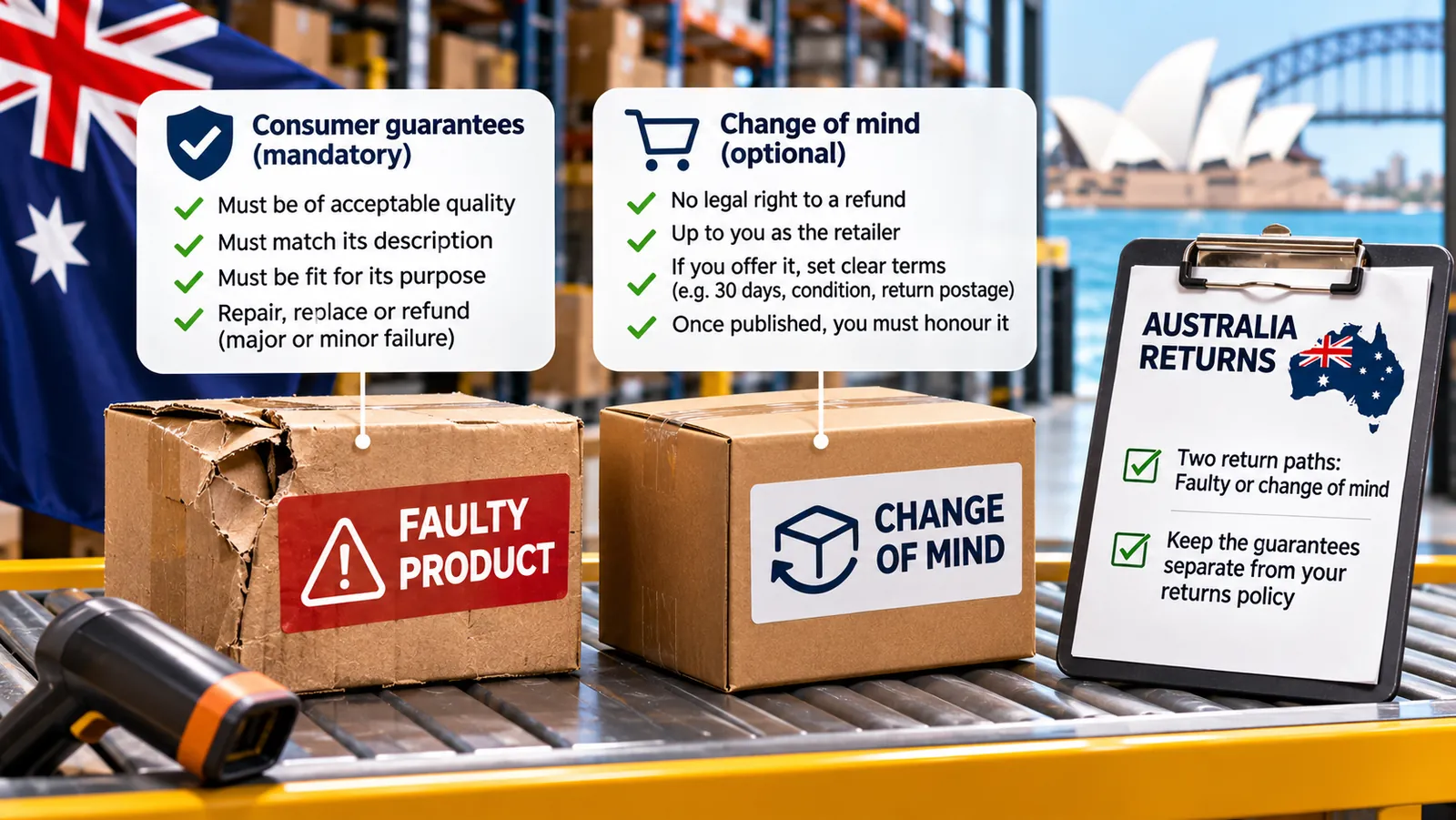
Australian brands don't have to accept change-of-mind returns unless their own policy offers them. They do have to repair, replace or refund products that fail a consumer guarantee, and returns wording that suggests otherwise is unlawful.
Brands entering Australia from the UK or the US often copy their home returns page and get caught by the second part. A "30 days, unworn, original packaging" rule is fine for change of mind. Applied to a faulty product, the same words break the law. The fix is mostly wording, plus a returns process in the warehouse that keeps the two kinds of return apart.
Last checked: 24 November 2026, against ACCC guidance on consumer rights and guarantees and fines and penalties. General information on the Australian Consumer Law. For your own policy, check the ACCC's guidance or take legal advice.
The consumer guarantees
Every product you sell to an Australian consumer comes with automatic guarantees under the Australian Consumer Law. It must be of acceptable quality, which covers being safe, durable and free from defects. It must match its description and any sample or demonstration model, and it must be fit for any purpose the customer told you about before buying.
These guarantees sit alongside any warranty you offer, and they last for a reasonable time given the product and its price. A manufacturer's 12-month warranty doesn't end them at 12 months if a reasonable customer would expect the product to last longer. They also apply to overseas sellers. If you sell to Australian consumers, from a site in London or a warehouse in Sydney, the guarantees come with the sale.
Major and minor failures
When a product fails a guarantee, the remedy depends on how serious the failure is. A failure is major when a reasonable customer wouldn't have bought the product had they known about the problem, when the product is significantly different from its description, when it is substantially unfit for its usual purpose or the purpose the customer told you about, or when it is unsafe. For a major failure, the customer chooses: a refund, or a replacement, or to keep the product and be compensated for the drop in its value.
A minor failure is one that can be fixed within a reasonable time. Here you choose the remedy, repair, replacement or refund, and you must act within a reasonable time. If you don't, the customer can have it fixed elsewhere and recover the reasonable cost, or treat it as a major failure.
Customers can also recover reasonably foreseeable losses caused by the failure. In the ACCC's words, these rights "cannot be excluded, restricted or modified."
Change of mind is your choice
Change of mind sits outside the guarantees. A customer who ordered the wrong size or no longer likes the colour has no legal right to a refund, and Consumer Protection WA confirms that a notice saying you don't give refunds for a change of mind is acceptable.
Plenty of brands offer change-of-mind returns anyway, because a clear returns offer lifts conversion online. If you do, publish the terms plainly: how many days, what condition the item must be in, who pays return postage, and whether you give a refund or store credit. Once published, those terms are a promise, and you must honour them.
If you offer a warranty
A warranty is optional, and many brands offer one to stand out. If you give a warranty against defects, the document has to include mandatory text set by regulation, which tells customers that your goods come with guarantees under the Australian Consumer Law that can't be excluded, and explains their rights to a remedy for major and minor failures. The ACCC publishes the exact wording. Copy it word for word into your warranty card and website, and make sure your warranty terms don't promise less than the guarantees already give.
Wording the regulators warn against
Consumer Protection WA lists returns wording generally considered unlawful, and it applies to a website as much as a shop counter:
"No refunds"
"No refunds on sale items"
"No refunds after seven days"
"Refunds on unworn items only"
"We will only exchange, repair or give credit notes"
Sale items carry the same guarantee rights as full-price stock. The one exception is a product discounted because of a fault you pointed out before the sale. The stakes went up this year. For conduct from 28 March 2026, the maximum penalty for a company making false or misleading representations is the greater of $100 million, three times the benefit gained, or 30% of adjusted turnover during the breach period.
Return postage on faulty goods
Postage is where online sellers most often go wrong. When a faulty product can't be returned without significant cost to the customer, because it is bulky, heavy or installed, you must collect it at your own expense. Asking a customer to pay freight on a faulty sofa is the kind of condition that turns a minor complaint into a regulator's question.
For smaller items, most online brands issue a prepaid return label for faulty goods once the customer sends photos. It keeps the claim simple, gets the item back to your 3PL for inspection quickly, and removes the cost of postage as a reason for a dispute. For bulky products, agree a collection process with your carrier or 3PL before you launch.
A returns page that works
The simplest fix is to split the page in two. The first part covers faulty products: the customer's consumer guarantee rights apply in full, with a short explanation of how to start a claim, what photos help, and a link to the ACCC. The second part covers change of mind: your own terms, or a plain statement that you don't offer change-of-mind returns.
Keep the language plain and avoid any line that could be read as limiting the first part. A condition such as "items must be unworn" belongs only in the change-of-mind section.
Setting your 3PL up for two kinds of return
Record the return reason at intake, faulty or change of mind, using the reason the customer gave when they started the return.
Photograph every faulty return on arrival and note its condition, so you have a record if a customer disputes a minor failure call.
Hold faulty items in a separate location until you decide on repair, replacement, refund or a claim against your supplier.
Grade change-of-mind returns against your published terms, and restock only those that meet them.
Agree turnaround times in writing, because a refund delayed while a parcel sits unopened can become a complaint.
Our guide to returns policies and 3PL costs covers what returns handling should cost per unit. If you're still choosing a warehouse, you can compare Australian 3PLs and ask each one to walk you through its returns process before you sign.
Need a logistics partner?
Tell Logan what you ship and where, and get a shortlist of partners that fit.
Submit an RFP


Comments
Share a question or insight about this article.