
What a US 3PL will ask you before quoting (and how to prepare)
Send a 3PL a vague brief and you get a vague quote, padded for risk. Here's the data pack that gets you a real number in days.
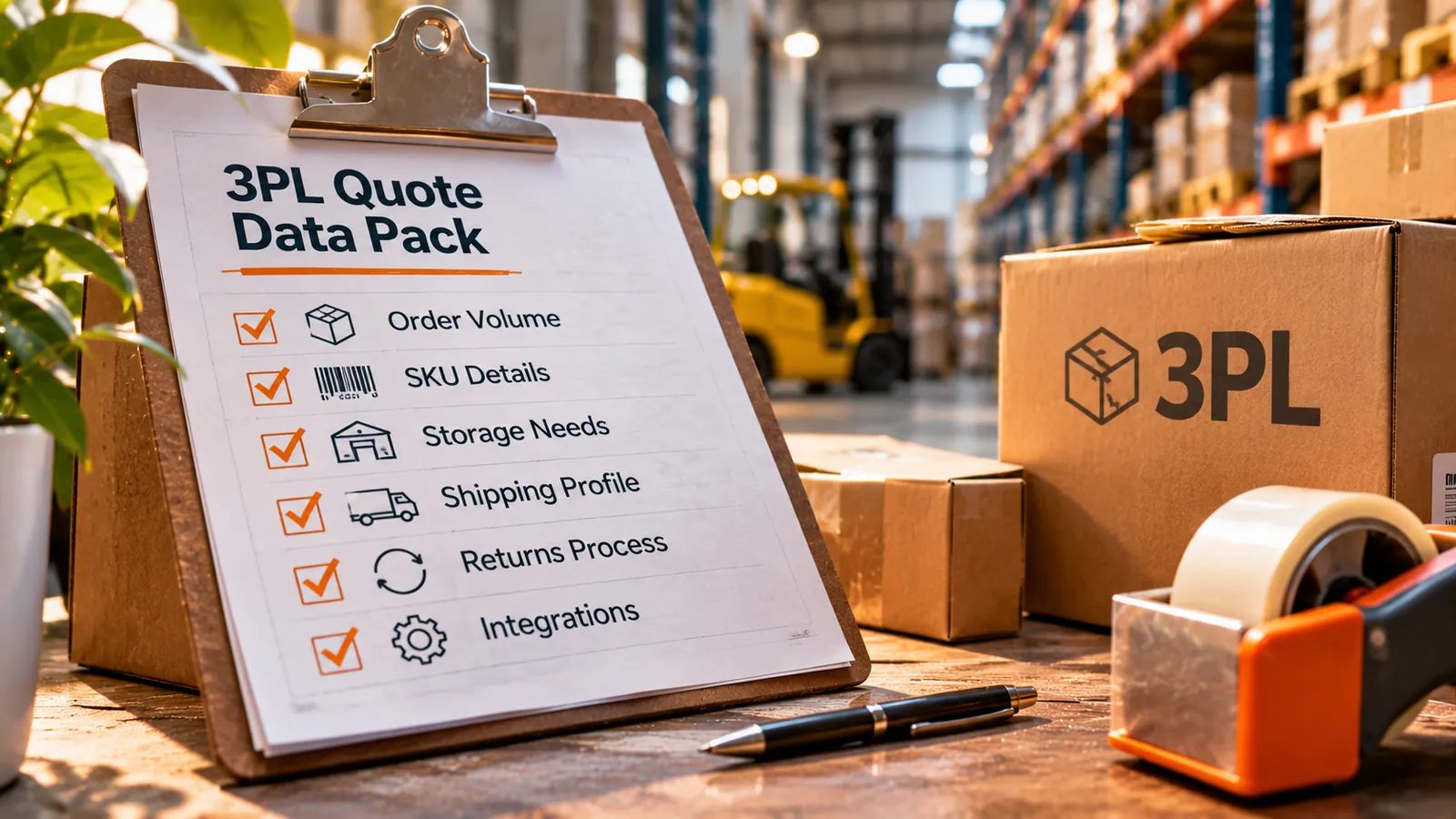
Before a US 3PL can quote accurately, it needs your order volume, units per order, product dimensions and weights, SKU count, inbound pattern, storage needs, sales channels, special handling, returns rate, seasonality, delivery promise and growth plan. Send all twelve up front and you'll get comparable quotes in days. Leave gaps and each warehouse fills them with its own guesses.
Those guesses are where quotes go wrong. One warehouse assumes two units per order and another assumes one, and suddenly the cheaper quote is the expensive one. Worse, the real price only appears after onboarding, when you are already committed. A complete data pack makes every quote answer the same question, and it shows warehouses you are a serious buyer worth pricing sharply.
Why gaps cost you money
A 3PL prices risk. When it doesn't know how your stock arrives or how many items go in each order, it assumes the expensive case or adds a buffer to protect itself. Both show up in your quote. A brand that sends a one-line brief gets padded quotes, and the 3PL that guessed lowest often corrects its price in month two.
A complete pack also speeds things up. Many warehouses reply within a week when they have everything they need, because they can go straight to pricing. Incomplete briefs take longer, because each warehouse has to come back with questions first, and you answer the same questions several times.
Volume, orders and products
Start with orders per month for the last 12 months, by month, pulled from Shopify or your order system. Warehouses staff to your busiest month, so they need to see it. Add units per order as an average and a spread, because "mostly one item, some bundles of three" changes the pick fee more than most brands expect.
Then add product dimensions and weights for your top 20 SKUs by volume, measured in their shipping packaging. Dimensional weight drives US shipping cost, so a warehouse can't price postage without them. Give your active SKU count too, with how many are slow movers, because every SKU needs a pick location and slow movers tie up space.
Inbound and storage
Describe how stock arrives: parcels, pallets or containers, how often, and whether containers are floor-loaded or palletized. Unloading a floor-loaded 40-foot container is a labor job with its own charge, so the answer goes straight into receiving fees. If you're unsure, ask your freight forwarder how your last three shipments arrived.
Then estimate storage: how many pallets or shelf locations you'd fill on day one, and at peak. A rough number with a note on how you worked it out is far more useful than no number. If you hold stock elsewhere today, your current storage invoice gives you a starting point, and so does the number of pallets on your last purchase order.
Channels, handling and returns
List your sales channels, such as Shopify, Amazon, TikTok Shop, wholesale and retail. Each needs an integration, and retail orders bring routing guides and labeling rules. Note any special handling: lithium batteries, liquids, aerosols, food, supplements, high-value items, kitting, gift notes or custom packaging. Add your returns rate by product line and what should happen to returned items.
Peaks, delivery promise and growth
Give your peak months and how much volume rises. A brand that triples in Q4 needs a warehouse with room and labor for it. State where your customers are and the delivery speed you offer, since two-day coverage of the whole country may mean two warehouses. Finish with your growth plan for the next 12 months, including new channels or products.
Why each number moves the price
Two brands can both ship 3,000 orders a month and get very different quotes. Take a made-up Brand A that ships one small item per order in a mailer, with 80 SKUs arriving on pallets. Brand B ships three items per order in a box, with 900 SKUs arriving in floor-loaded containers and a third of them selling less than once a month.
Brand B needs more pick locations, more labor per order, more packaging and container unloading, so its per-order cost will be higher at the same volume. A 3PL that only heard "3,000 orders a month" would quote both brands the same and correct the price after onboarding. That correction is the surprise invoice brands complain about in month two.
Build the pack in one afternoon
Export 12 months of orders by month, with units per order.
Measure and weigh your top 20 SKUs in their shipping packaging.
Ask your forwarder how your last three shipments arrived.
Estimate pallets or shelf locations for day one and peak.
List channels, special handling and returns rates by product line.
Write your peak months, delivery promise and 12-month growth plan.
Put it all in one spreadsheet and send the same file to every warehouse.
What the warehouse will ask on the first call
Even with a full pack, expect a call. A good 3PL will ask how you work today and what has gone wrong: why you're moving, what your current provider gets wrong, and what a good month looks like. It will ask how fast you need to go live, because onboarding usually takes several weeks and a peak-season start changes its plans. It may also ask about your systems, such as Shopify apps, an ERP or an inventory tool, so it can check its integrations.
Answer these honestly. A warehouse that understands why your last move went wrong can price and plan around it, and one that hears only good news will be surprised later.
What you can keep private
You don't need to share your current 3PL's prices. Share volumes and requirements, and let each warehouse price them, then use your current costs for your own comparison afterward. Customer-level data isn't needed either. The summary numbers in this pack identify no customer, so most brands share them without an NDA and keep the NDA for the later stage, when order files and system access come into play.
Need a logistics partner?
Tell Logan what you ship and where, and get a shortlist of partners that fit.
Submit an RFP

Comments
Share a question or insight about this article.