
Fulfilment Belongs in Your Unit Economics
A product with a healthy gross margin can still lose money per order. Add fulfilment, returns and marketing to find your real contribution margin.
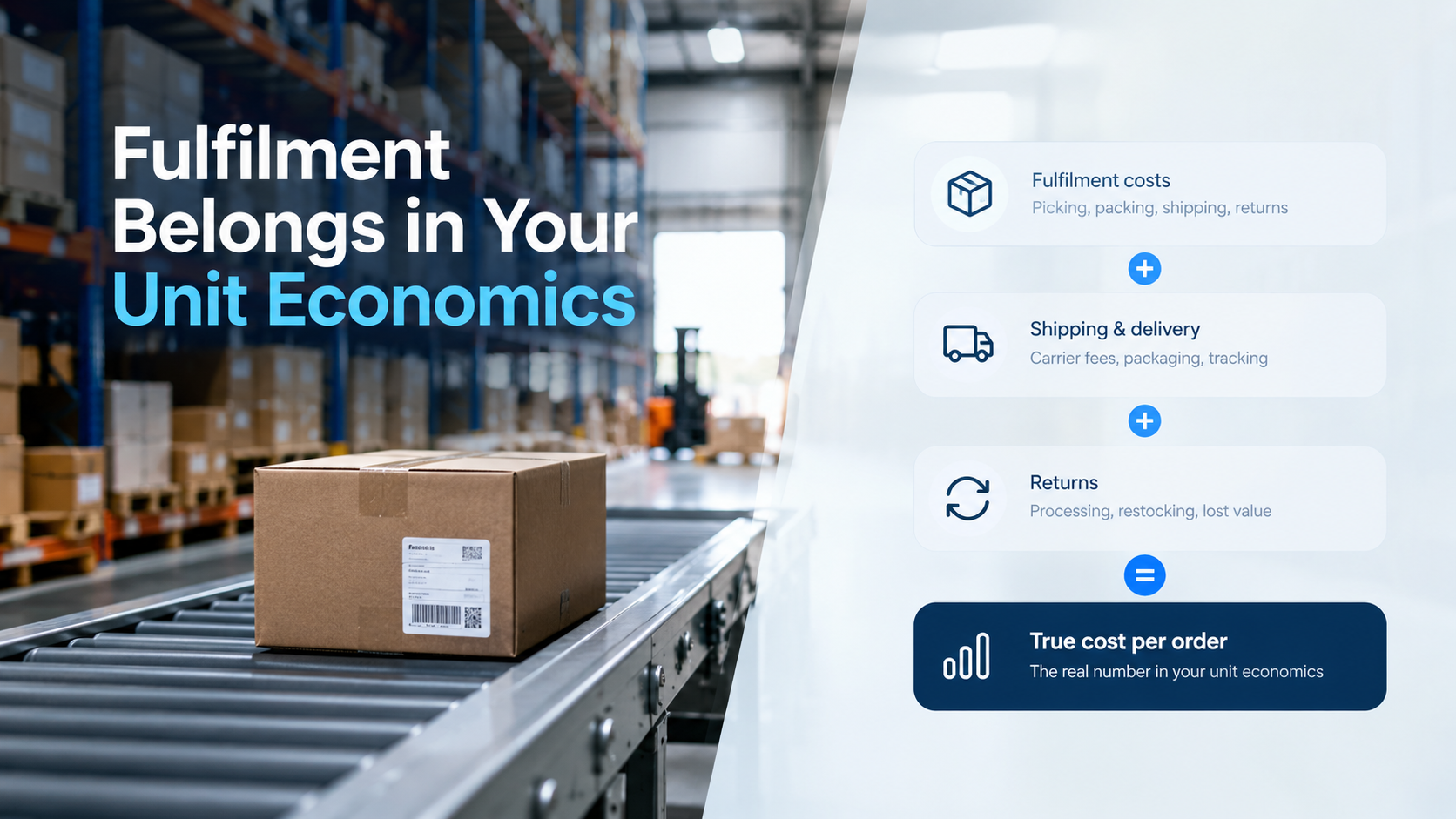
A product with a healthy gross margin can still lose money on every order. Most founders carry pick fees, packaging and postage in a monthly overhead line, so no single product ever shows what it costs to ship. Put the full cost of fulfilling one order next to the price of that product and the real contribution margin appears. This guide shows the sum with an invented example, then what to do with the answer.
The pain points
Gross margin looks healthy and the bank balance says otherwise.
Postage, packaging and pick fees sit in overheads, so a £15 product and a £60 product look equally profitable.
A 3PL quote arrives as a per-order figure and your spreadsheet has nowhere to put it.
Returns cost money on orders that never earned a penny.
What contribution margin means
Contribution margin per order is what the customer pays, minus every cost that exists because that order exists. For an online store that means the product itself, the payment fee, picking and packing, packaging, postage, an allowance for returns and the marketing spend that won the order. Rent, salaries and software are overheads and stay out of the sum. What is left is the amount each order contributes towards those overheads and towards profit.
A worked example with invented numbers
These figures are made up to show the method. Use your own.
Product A sells for £40.00:
Product cost: £14.00
Payment fee: £1.10
Pick and pack: £1.50
Packaging: £0.70
Postage: £3.40
Returns allowance: £1.60
Contribution before marketing: £17.70
Marketing cost per order: £9.00
Contribution after marketing: £8.70
Product B sells for £18.00:
Product cost: £6.00
Payment fee: £0.55
Pick and pack: £1.50
Packaging: £0.70
Postage: £3.40
Returns allowance: £0.80
Contribution before marketing: £5.05
Marketing cost per order: £9.00
Contribution after marketing: minus £3.95
Product B has a gross margin of about 67 percent, which looks strong on a sheet that stops at product cost. After fulfilment and marketing, every order loses £3.95. The fulfilment costs of pick, pack, packaging and postage add up to £5.60 on both products. That is 14 percent of Product A's price and 31 percent of Product B's. The same parcel costs the same to send, whatever the product inside is worth.
Where to find your numbers
Pick and pack, storage and packaging: your 3PL invoice or rate card. Our guides to pick and pack pricing and cost per order list the lines to expect.
Postage: your carrier invoices, grouped by weight band. Box size changes this figure, so read our guide to volumetric weight.
Payment fees: your payment provider statement.
Returns: your return rate multiplied by the cost of one return. Your returns policy sets that cost.
Marketing: ad spend divided by orders, from your ad platform.
Our recommendation: build the sheet in an afternoon
Export the last 90 days of orders and group them by product or by typical basket.
Add each cost line from real invoices.
Add a returns allowance and the marketing cost per order.
Flag every product whose contribution is below zero, and every product below a minimum you set, for example £5 per order.
Pick one action for each flagged product: raise the price, bundle it with a better seller, set a minimum basket for it, change the packaging, or stop selling it.
Keep the sheet and refresh it whenever your 3PL rates or carrier rates change. It also gives you the exact figures to use when you run a 3PL tender.
What waiting costs
If Product B in the example sells 300 orders a month, it loses £1,185 a month and £3,555 a quarter. The loss repeats every month it goes unchecked, and extra sales make it bigger. The sheet takes an afternoon, and it shows which products to fix before the next ad budget goes into them.
People Also Ask
What is contribution margin in ecommerce?
It is the money left from one order after every cost that order causes, such as product cost, payment fees, fulfilment, postage, returns and marketing. It shows what each order adds towards overheads and profit.
Should fulfilment costs go in cost of goods sold?
How you record them in your accounts is a question for your accountant. For pricing and product decisions, count fulfilment against each order, because that is where the cost happens.
How do I find my fulfilment cost per order?
Add pick and pack, packaging, postage and your share of storage from your last few invoices, then divide by the number of orders shipped in the same period.
Finding the right 3PL partner
FulfilQ's advisor, Logan, matches brands to verified providers by order volume, product type and region. Tell Logan what you ship and where it goes, and you get a shortlist with rates you can drop into this sheet. Start at fulfilq.com or browse the full provider directory.




Comments
Share a question or insight about this article.