
Warehouse liens: what US brands should know before signing with a 3PL
A US 3PL can hold your inventory for unpaid storage charges under UCC 7-209. What a warehouse lien covers, how to limit it in your contract and how to exit cleanly.
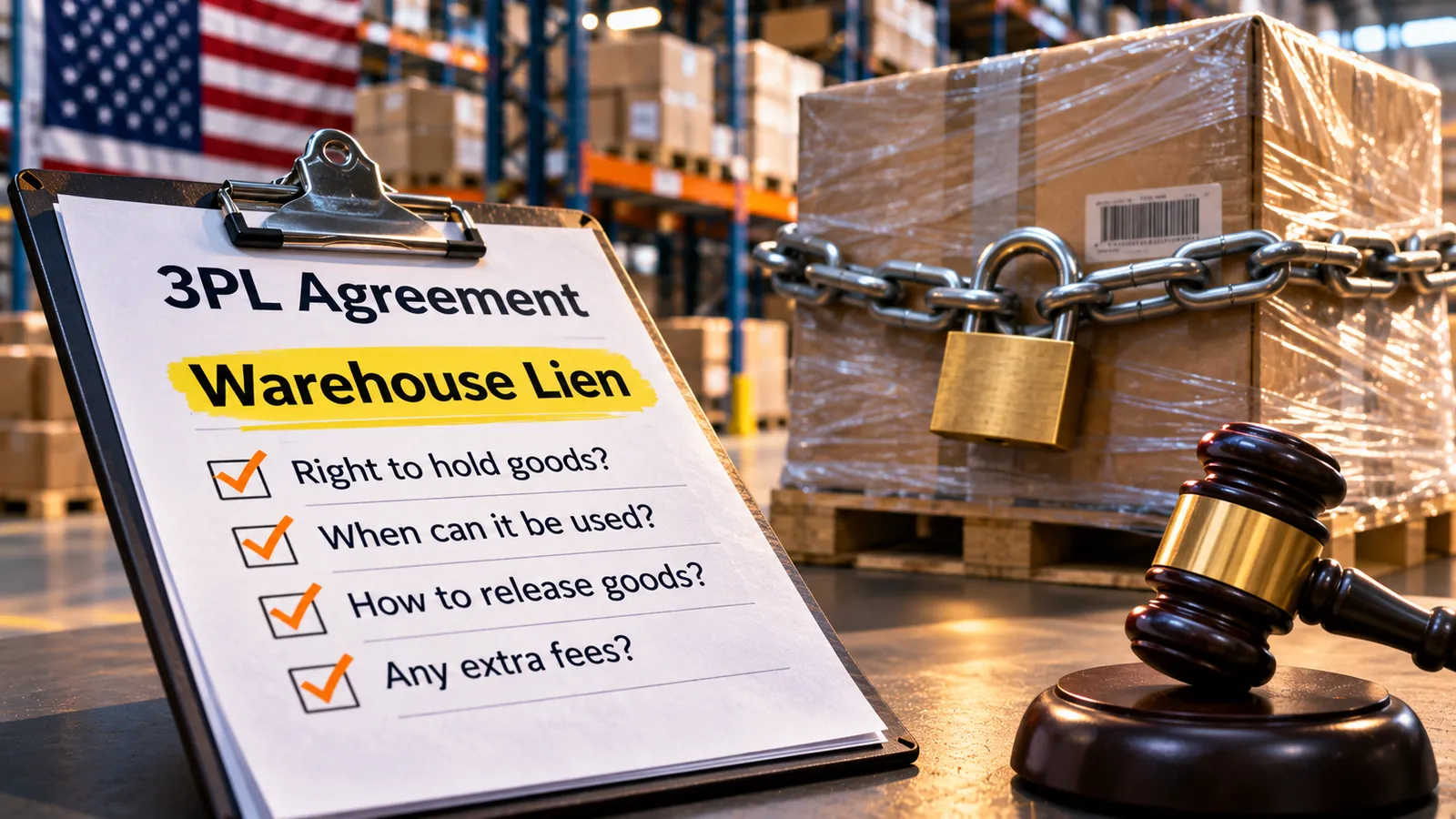
Yes, in most US states a 3PL can legally hold your inventory over unpaid charges. Under Uniform Commercial Code section 7-209, a warehouse has a lien on the goods it stores for storage, handling, insurance and related charges, and it can keep the goods until those charges are paid. Your contract decides how far that lien reaches, so read it before you sign.
Last checked: 14 November 2026. This article explains the general rule under the Uniform Commercial Code, which most states have adopted with local variations. It is general information. Take advice from a lawyer licensed in your state on your own contract or dispute.
The pain points
"We disputed one invoice and the 3PL stopped shipping every order until we paid the lot."
"We gave notice to move warehouses and they won't release our pallets until we clear charges we think are wrong."
"I didn't know the storage agreement let them hold all our stock for one overdue bill."
"Black Friday is two weeks away and our inventory is sitting in a building we can't ship from."
My 3PL won't release my inventory over a billing dispute. Can they do that?
Often, yes. Section 7-209(a) gives the warehouse a lien for "charges for storage or transportation," plus insurance, labor and expenses needed to preserve the goods. The lien sits on the goods in the warehouse's possession and their proceeds. While the charges stay unpaid, the warehouse can refuse to hand the goods over.
Two kinds of lien matter for a brand:
A specific lien covers the charges for the particular goods in question. If you owe storage on one batch of pallets, the warehouse can hold that batch.
A general lien lets the warehouse hold goods for charges owed on other goods too, even goods it has already shipped. Section 7-209 allows this only when the warehouse receipt or storage agreement states that a lien is claimed for charges on other goods.
The general lien is why one overdue invoice can freeze your whole inventory. Check whether your storage agreement contains that wording.
When the lien ends, and what a sale requires
Under section 7-209(e), the warehouse loses its lien on goods it "voluntarily delivers or unjustifiably refuses to deliver." Once your orders ship normally, the lien on those units is gone. A warehouse that holds goods without a valid charge behind them is refusing delivery without justification.
If charges stay unpaid, section 7-210 lets the warehouse sell the goods to cover the debt. The sale must be commercially reasonable, and the warehouse must first notify everyone known to claim an interest, stating the amount owed and the type of sale. Before the sale, anyone claiming rights in the goods can pay the lien amount plus reasonable costs, and the goods must then stay in storage. Any surplus from a sale is held for the owner. A warehouse that ignores these rules owes damages.
What to put in your 3PL contract
Most lien problems are decided by the agreement you sign. Ask for these points before you move stock in:
Specific lien only. Remove or narrow any clause claiming a lien on all goods for any charges. A lien limited to the goods tied to a disputed invoice keeps the rest of your inventory shipping.
Disputed charges carved out. Charges disputed in good faith and in writing within an agreed window should sit outside the lien while the dispute is resolved.
Keep shipping during a dispute. A clause that orders keep flowing while undisputed invoices are paid protects your customers and your revenue.
An exit and transition clause. State the notice period, the steps for releasing inventory, the final reconciliation of charges and who pays for outbound freight and labor at exit.
Inventory reports you control. Regular stock reports by SKU and location give you a record of what the warehouse holds, which matters if a dispute starts.
Our guide to 3PL contract terms covers the other clauses worth negotiating, and questions to ask a 3PL helps you raise them early.
If you are already in a dispute
Pull the storage agreement and find the lien clause. Note whether it is specific or general.
Split the invoices into undisputed and disputed lines, and pay the undisputed lines promptly.
Put the disputed lines in writing, with the reason and the evidence, and ask for a call.
Ask the warehouse to release the goods not covered by the disputed charges.
If the goods are needed urgently, consider paying the disputed amount under written protest while you resolve it, and take legal advice before you do.
What to ask a 3PL
Does your storage agreement claim a general lien on all our goods, or a specific lien only?
Will you keep shipping our orders while an invoice is disputed in good faith?
How long do we have to dispute an invoice, and how do you handle disputed lines?
What notice do you need to release our inventory at the end of the contract, and what do you charge for it?
How often will you send inventory reports by SKU and location?
Our recommendation: narrow the lien before you move a single pallet
Read the lien clause in every storage agreement before signing.
Negotiate a specific lien, with good-faith disputes carved out.
Add a clause that keeps orders shipping while undisputed invoices are paid.
Agree the exit steps, notice and costs in writing.
Reconcile invoices monthly, so disputes stay small.
Have a lawyer licensed in your state review the agreement if your inventory value is significant.
What waiting costs
A general lien discovered in a dispute gives the warehouse leverage over your whole business at the worst moment, usually right before a peak or a move. Every day your inventory is held, orders go unshipped, ad spend keeps running and customers wait.
These figures are made up to show the method. A brand ships 3,000 orders a month at an average order value of $60, about $6,000 of revenue a day. It disputes a $4,500 storage invoice, and the agreement holds a general lien. If the warehouse stops shipping for ten days, the brand delays or loses about $60,000 of sales over a $4,500 disagreement. A specific lien would have frozen only the pallets tied to that invoice.
People Also Ask
What is a warehouse lien?
It is a legal right for a warehouse to hold the goods it stores until the charges for storing and handling them are paid. In the US it comes from section 7-209 of the Uniform Commercial Code, as adopted by each state.
Can a 3PL sell my inventory if I don't pay?
Under section 7-210 it can, after notifying everyone known to claim an interest and through a commercially reasonable sale. You can stop the sale by paying the lien amount plus reasonable costs before it happens.
What is a general lien in a storage agreement?
It lets the warehouse hold any of your goods for charges owed on other goods, including goods already shipped. It applies only when the receipt or storage agreement says so, which is why the clause is worth negotiating.
Finding the right 3PL partner
Logan, FulfilQ's advisor on the website, matches brands to verified providers by order volume, product type and region. Tell Logan your monthly orders, how many pallets you store and where your customers are, and you get a shortlist to ask about lien terms, dispute handling and exit steps. Start at fulfilq.com and Ask Logan, or Submit an RFP and verified providers come back to you. You can also browse the full provider directory.




Comments
Share a question or insight about this article.