
Warehouse automation in 3PLs: what it means for your fulfilment costs and what to ask
What 3PL warehouse automation changes for ecommerce brands: robots, auto-packing, sortation and WMS, the effect on cost per order, and the questions to ask.
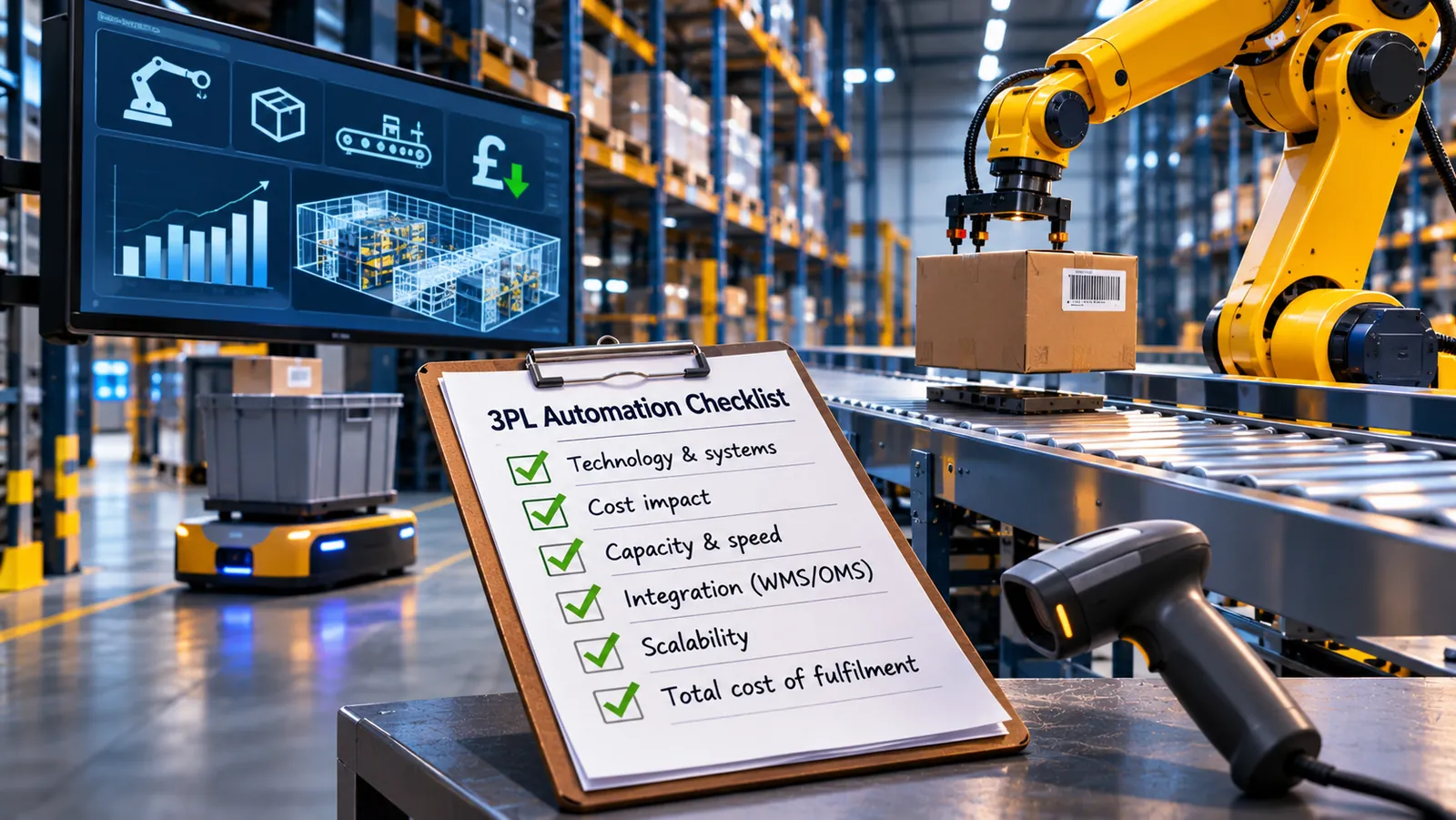
3PL warehouse automation is the robots, machines and software a fulfilment provider uses to store, pick, pack and sort orders. Ecommerce brands buy it through their 3PL, and it shows up in the price per order, the capacity you get at peak, pick accuracy and the size of the boxes your orders leave in.
This guide covers the main types of automation, what each one changes for a brand, what stays the same, and how to judge whether it matters at your volume.
The pain points
Every 3PL sales deck shows robots, and I can't tell whether any of them touch my orders.
The automated warehouse quoted us more per month than the manual one, and I don't know why.
We pay to ship air because our products go out in boxes far bigger than they need.
Last December our 3PL ran out of people and our orders sat for three days.
I want to know if automation is worth paying for at 2,000 orders a month.
The kinds of automation you will meet in a 3PL
Most fulfilment warehouses mix manual work with some automation. These are the systems you are most likely to see on a site visit.
Goods-to-person picking: storage systems bring shelves, totes or bins to a picker at a fixed station, so nobody walks the aisles.
Autonomous mobile robots (AMRs): robots that move around the building on their own. Some carry shelving units to pickers, others carry totes alongside them.
Automated packing and right-sized cartons: machines measure each order and make a box or mailer to fit it, or pick the closest standard size. Less empty space means less void fill and a smaller parcel.
Sortation: conveyors and sorters scan packed parcels and send them to the right carrier lane, which speeds up the end of the day.
WMS with real-time stock: the warehouse management system tracks every unit by scan and sends stock levels to your shop. This is the one piece of automation every brand needs, at any volume.
What each one changes for your brand
Cost per order at scale. Equipment is a fixed cost the 3PL spreads over all its clients' orders, and it cuts labour. That can mean a lower pick and pack rate once volume is high, often with a monthly minimum or a technology fee attached. Our guide to fulfilment unit economics shows how to build that cost per order.
Peak capacity. A manual site grows at peak by hiring temporary staff, who need training. An automated site can often run more hours on the same equipment. It still has a ceiling, so ask what it is. Our article on 3PL peak season capacity covers how to book your share early.
Accuracy. Scan checks at each step catch the wrong item before it ships. Ask for the measured pick accuracy on accounts like yours, and how the 3PL counts it.
Dimensional weight. Many carriers charge on the greater of actual weight and volumetric weight. UPS in the UK divides length by width by height in centimetres by 5,000 and bills the greater of the two figures. Parcelforce uses the same 5,000 divisor for international parcels to zones 4 to 12. A right-sized carton can drop a light, bulky order into a cheaper weight band. Our guide to volumetric weight works through the maths. Carrier terms change, so check them before you budget.
What automation does not change
Your carrier rates. Automation can shrink the parcel, but the price per band comes from your carrier contract.
Bad inbound data. If your deliveries arrive without accurate notices, barcodes or carton labels, robots slow down just like people do.
Awkward products. Very large, heavy, fragile or irregular items often go through a manual lane, even in an automated building.
Integration. If the link between your shop and the WMS breaks, orders stop, however fast the floor is.
Your contract. Minimums, notice periods and exit terms matter more once a 3PL has invested in kit for your account. Our guide to 3PL contract terms covers what to check.
What the surveys say, and how far to trust them
Robotics surveys ask warehouse operators in general, often in the US, so treat their figures as directional for a UK brand choosing a 3PL. The fifth annual Intralogistics Robotics Survey, run by Peerless Research Group with MHI and The Robotics Group, reached 166 subscribers of the US trade title Modern Materials Handling in March and April 2026. 52% said they currently use one or more types of robots, and another 32% plan to within three years. 74% said robotics met their business goals, while 21% said it fell short. ROI (63%) and payback time (52%) topped their decision criteria. Asked for the single most important factor, 67% named labour costs.
That last point matters in the UK too. The National Living Wage for workers aged 21 and over is £12.71 an hour from April 2026, with £13.21 listed for April 2027. Manual pick and pack rates sit on top of wage costs. Our State of Ecommerce Fulfilment 2026 report has a chapter on technology and automation.
Does automation matter at your volume?
Answer three questions about your own business first.
Does your product suit it? Small, light, boxable items in totes suit goods-to-person and auto-packing. Bulky or fragile items may never touch the automated lane.
Is your volume steady and high enough? Ask each 3PL at what monthly order volume your account would run on its automated lanes, and what the minimum charge is.
Is your peak much bigger than your normal month? If December is three or four times a normal month, extra capacity without temporary staff has real value.
Then compare quotes on the full cost per order, including packaging, technology fees and the shipping effect of carton size. Our guide on how to choose a 3PL in the UK covers the rest of the decision.
What to ask a 3PL
Which parts of my order flow will be automated, and which will stay manual?
At what monthly volume do my orders go through the automated lanes?
Is there a technology fee, a monthly minimum or a setup charge tied to automation?
How do you choose carton sizes, and can you show the average fill rate for an account like mine?
What was your measured pick accuracy last quarter, and how do you count it?
What is your peak daily capacity, and how much of it is booked already?
What happens to my orders when a robot, sorter or packing machine goes down?
How often does your WMS sync stock to my shop, and who fixes a failed sync?
Our recommendation: judge automation by your cost per order
Pull a month of order data: orders, units per order, product sizes and the carrier services you use.
Mark which products could run through automated picking and packing, and which could not.
Send the same data to each 3PL you are comparing and ask for a full cost per order.
Ask each automated 3PL for its carton sizing on your top ten products, then work out the billable weight against your carrier's divisor.
Add technology fees and minimums, then compare the total at your normal month and your peak month.
Visit the site and watch your type of product go through it.
Put accuracy, peak capacity and machine downtime cover into the service level agreement.
What waiting costs
Choosing on the headline pick rate alone can lock you into a contract that costs more at your real volume, or misses a shipping saving every month. Peak space goes to brands that book early, so a late decision can leave you with whatever is left. On a 12-month contract, a wrong choice repeats every month until you can leave.
Take a brand shipping 2,500 orders a month. A manual 3PL quotes £1.90 pick and pack plus £0.35 packaging per order, which is £5,625 a month. An automated 3PL quotes £1.70 plus £0.30 packaging and a £350 monthly technology fee, which is £5,350. Right-sized cartons also cut 0.5 kg of billable weight on the 1,000 orders billed on volume, worth £0.60 per kg on this brand's carrier rates, so £300 a month. The automated option saves £575 a month, or £6,900 over a 12-month contract. At 800 orders a month, with the same share billed on volume, the same quotes come out the other way: £1,800 manual against £1,854 automated after the shipping saving. These figures are made up to show the method.
People Also Ask
Are automated 3PLs cheaper?
They can be at higher, steady volumes, because the 3PL spreads the cost of the equipment over many orders. At low volume, technology fees and minimums can make them dearer. Compare the full cost per order at your normal month and your peak month.
Can warehouse automation lower my shipping costs?
Yes, through carton size. Many carriers bill the greater of actual and volumetric weight, so a smaller box can move a light, bulky order into a lower price band. Your carrier rates themselves stay the same.
What is goods-to-person picking?
It is a system where storage bins, totes or shelves come to a picker at a fixed station. The picker takes the items for each order without walking the aisles. It suits small items that fit in totes.
Finding the right 3PL partner
Logan, FulfilQ's advisor on the website, matches brands to verified providers by order volume, product type and region. Tell Logan your monthly orders, your product sizes and how big your peak gets, and you get a shortlist to ask about automated picking, right-sized packing and peak capacity. Start at fulfilq.com and Ask Logan, or Submit an RFP and verified providers come back to you. You can also browse the full provider directory.

Comments
Share a question or insight about this article.