
Unlocking TikTok Shop Fulfilment Success
Three years ago, most ecommerce founders worried about Facebook ads. Today, many are worrying about something entirely different. What happens if a product suddenly sells 5,000 units in 48 hours?
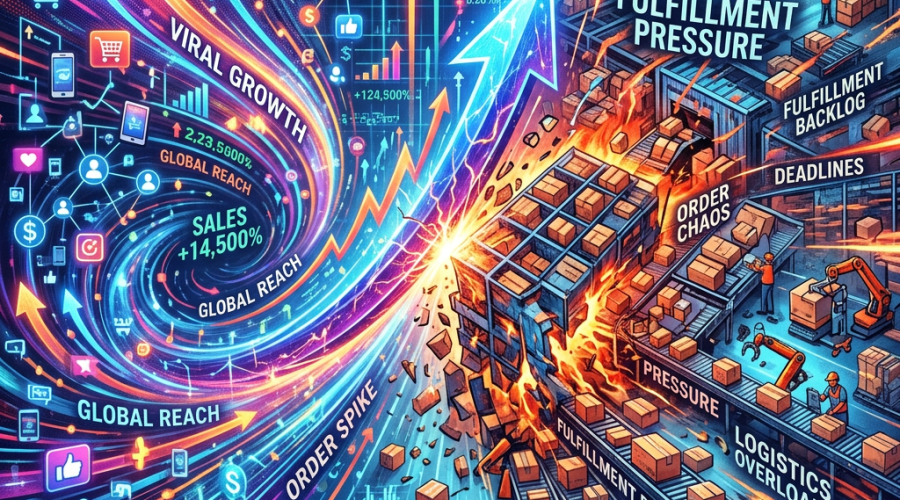
Three years ago, most ecommerce founders worried about Facebook ads.
Today, many are worrying about something entirely different.
What happens if a product suddenly sells 5,000 units in 48 hours?
That is the reality of TikTok Shop.
Social commerce has fundamentally changed how products are discovered and purchased. Instead of a carefully managed growth curve, brands can experience explosive demand almost overnight.
For some businesses, that creates extraordinary opportunities.
For others, it creates operational disasters.
The problem is simple.
Traditional ecommerce fulfilment models were not designed for viral commerce.
As a result, TikTok Shop fulfilment has become one of the biggest operational challenges facing modern ecommerce brands.
Why TikTok Shop Is Different
Most ecommerce growth channels are relatively predictable.
Paid advertising can be scaled gradually.
Email marketing performance is generally stable.
Organic search growth tends to happen over months rather than days.
TikTok behaves differently.
A creator can post a video at lunchtime.
By dinner time, thousands of orders may have arrived.
This creates a completely different fulfilment challenge.
Brands suddenly need to answer questions such as:
- Can we fulfil ten times our normal volume?
- Do we have enough inventory?
- Can our warehouse cope?
- Will our delivery experience suffer?
- How quickly can we replenish stock?
Businesses that cannot answer these questions often struggle when products go viral.
The Viral Commerce Problem
Traditional demand forecasting relies heavily on historical data.
TikTok frequently ignores historical patterns.
A product that sold 20 units yesterday may sell 2,000 tomorrow.
Then return to normal next week.
This unpredictability creates enormous pressure across:
- inventory planning
- warehousing
- staffing
- customer support
- replenishment
Consequently, many brands discover that their existing fulfilment processes are simply not designed for social commerce.
Why Fulfilment Fails During Viral Growth
Interestingly, fulfilment failures rarely occur because warehouses are incapable.
Instead, they happen because systems lack flexibility.
Common failure points include:
Inventory Visibility
Brands often do not know exactly how much stock is available.
When sales accelerate rapidly, overselling becomes common.
Manual Processes
Spreadsheets and manual order processing quickly become bottlenecks.
Single-Person Operations
Many growing brands still rely heavily on founders or small teams.
Viral demand can overwhelm these resources within hours.
Limited Warehouse Capacity
Many growing brands still rely heavily on founders or small teams.
Viral demand can overwhelm these resources within hours.
The Cost of Getting TikTok Shop Fulfilment Wrong
A viral product should be a dream scenario.
Yet for many brands it becomes a customer experience nightmare.
Common issues include:
- delayed dispatch
- cancelled orders
- stockouts
- poor communication
- refund requests
According to PwC, 32% of customers will stop doing business with a brand after one poor experience.
Source:
https://www.pwc.com/gx/en/services/consulting/consumer-markets/consumer-insights-survey.html
This means a single viral event can either create thousands of loyal customers or thousands of disappointed ones.
The difference often comes down to fulfilment.
Five Questions Every TikTok Shop Seller Should Ask
Before investing heavily in TikTok Shop, ask yourself the following.
1. What Happens If Sales Increase Tenfold Tomorrow?
Most brands never ask this question.
They should.
Because on TikTok, it can happen.
2. How Quickly Can We Replenish Inventory?
Stockouts are common in social commerce.
Understanding supplier lead times is critical.
3. Do We Have Real-Time Inventory Visibility?
Without accurate inventory data, scaling TikTok sales becomes risky.
4. Can We Process Orders Seven Days Per Week?
Customer expectations on TikTok are increasingly aligned with Amazon-level experiences.
Slow fulfilment damages reviews and repeat purchases.
5. What Is Our Contingency Plan?
Growth should not depend upon everything working perfectly.
Strong operations include contingency planning.
Should TikTok Shop Sellers Use a 3PL?
Not every seller needs a third-party logistics provider.
However, many brands underestimate how quickly social commerce can create operational pressure.
A 3PL may become attractive when:
- order volumes fluctuate dramatically
- marketing activity is increasing
- founders spend more time packing than growing
- customer complaints are increasing
- expansion into multiple markets is planned
The biggest advantage is flexibility.
Modern ecommerce-focused 3PLs are often designed to absorb peaks more effectively than in-house operations.
Safety Stock
Holding additional inventory reduces the risk of stockouts during unexpected demand spikes.
Fast Replenishment Cycles
Long supplier lead times create risk.
SKU Rationalisation
Too many SKUs can make fulfilment unnecessarily complex.
Demand Monitoring
Products trending on TikTok should be monitored daily, not weekly.
Why Customer Communication Becomes Critical
Even the strongest fulfilment operation occasionally experiences delays.
The difference lies in communication.
Customers are often surprisingly understanding when:
- expectations are managed
- updates are proactive
- communication is transparent
Silence creates frustration.
Communication builds trust.
This is particularly important during viral growth events when customer expectations are high.
TikTok Shop Is Accelerating the Shift Towards Distributed Fulfilment
An interesting trend is emerging.
More brands are moving towards distributed fulfilment networks.
Rather than storing inventory in one location, businesses are increasingly positioning stock closer to customers.
Benefits include:
- faster delivery
- improved resilience
- stronger customer experience
As social commerce continues to grow, this trend is likely to accelerate.
The Bigger Picture
TikTok Shop is not simply another sales channel.
It represents a different operating model.
Brands that treat TikTok like traditional ecommerce often struggle.
Those that adapt operationally often outperform competitors.
Research from Grand View Research forecasts continued growth in social commerce globally, reinforcing the need for operational agility.
Source:
https://www.grandviewresearch.com/industry-analysis/social-commerce-market-report
The opportunity is enormous.
However, success increasingly depends on operational readiness.
Final Thoughts
Most ecommerce brands spend significant time planning their TikTok marketing strategy.
Far fewer spend the same amount of time planning their TikTok fulfilment strategy.
That imbalance creates risk.
Because on TikTok, growth can happen far faster than operations can adapt.
The brands that win in social commerce are rarely those with the best videos alone.
They are the brands capable of delivering consistently strong customer experiences when demand suddenly explodes.
In many cases, fulfilment becomes the difference between a viral moment and a sustainable business.
FAQs
Is TikTok Shop fulfilment different from traditional ecommerce fulfilment?
Yes. TikTok Shop often creates sudden demand spikes that require greater operational flexibility.
Can small brands succeed on TikTok Shop?
Absolutely. However, they should ensure operations can scale quickly if products gain traction.
Should TikTok sellers use a 3PL?
Many growing sellers benefit from using a 3PL, particularly when demand becomes unpredictable.
Why do TikTok products frequently sell out?
Viral content can generate demand significantly beyond normal forecasts, leading to stockouts.
What is the biggest fulfilment challenge for TikTok Shop sellers?
Managing unpredictable demand while maintaining delivery speed and customer experience.



Comments
Share a question or insight about this article.