
How to Choose a 3PL for Ecommerce Brands
At some point, almost every growing ecommerce business reaches the same crossroads. Orders are increasing. Inventory is expanding. Customer expectations continue to rise. Meanwhile, the warehouse, office or spare room that once handled fulfilment perfectly starts to feel like a bottleneck.
At some point, almost every growing ecommerce business reaches the same crossroads.
Orders are increasing.
Inventory is expanding.
Customer expectations continue to rise.
Meanwhile, the warehouse, office or spare room that once handled fulfilment perfectly starts to feel like a bottleneck.
The question is no longer whether fulfilment matters.
The question becomes:
How do you choose the right 3PL for ecommerce fulfilment?
This decision is more important than many founders realise.
A strong fulfilment partner can support growth, improve customer experience and create operational stability.
The wrong partner can create delays, frustration, rising costs and unhappy customers.
Yet many brands still choose a 3PL based on little more than price or location.
That approach rarely ends well.
This guide explains how to evaluate a 3PL for ecommerce, what questions to ask, what mistakes to avoid and how to identify the right fit for your business.
What Is a 3PL for Ecommerce?
A 3PL for ecommerce is a third-party logistics provider that stores inventory and fulfils
customer orders on behalf of online retailers.
Most ecommerce 3PL providers typically handle:
- inventory receiving
- warehousing
- order processing
- picking and packing
- shipping
- returns management
Instead of managing fulfilment internally, businesses outsource these activities to a specialist partner.
However, not all 3PLs are designed for ecommerce.
That distinction is critical.
Why Ecommerce Brands Use 3PLs
The reasons vary by business, but common drivers include:
- freeing up founder time
- reducing operational complexity
- improving delivery performance
- gaining access to fulfilment expertise
- supporting growth
As businesses scale, logistics often becomes more specialised.
Consequently, many brands find it more efficient to partner with a provider that already has the systems, infrastructure and processes in place.
A Market Trend Worth Noting
According to Grand View Research, the global third-party logistics market exceeded $1 trillion and continues to grow as ecommerce expands worldwide.
Source:
https://www.grandviewresearch.com/industry-analysis/third-party-logistics-market
The growth reflects increasing demand from businesses seeking operational efficiency and scalable fulfilment solutions.
Why Choosing the Wrong 3PL Can Be Expensive
Most founders focus on fulfilment pricing.
That is understandable.
However, the real cost of a poor provider often sits elsewhere.
Examples include:
- delayed orders
- inaccurate shipments
- poor communication
- inventory issues
- customer complaints
- negative reviews
These costs rarely appear on a monthly invoice.
Nevertheless, they can significantly impact growth.
For this reason, choosing a 3PL for ecommerce should be viewed as a strategic decision rather than a procurement exercise.
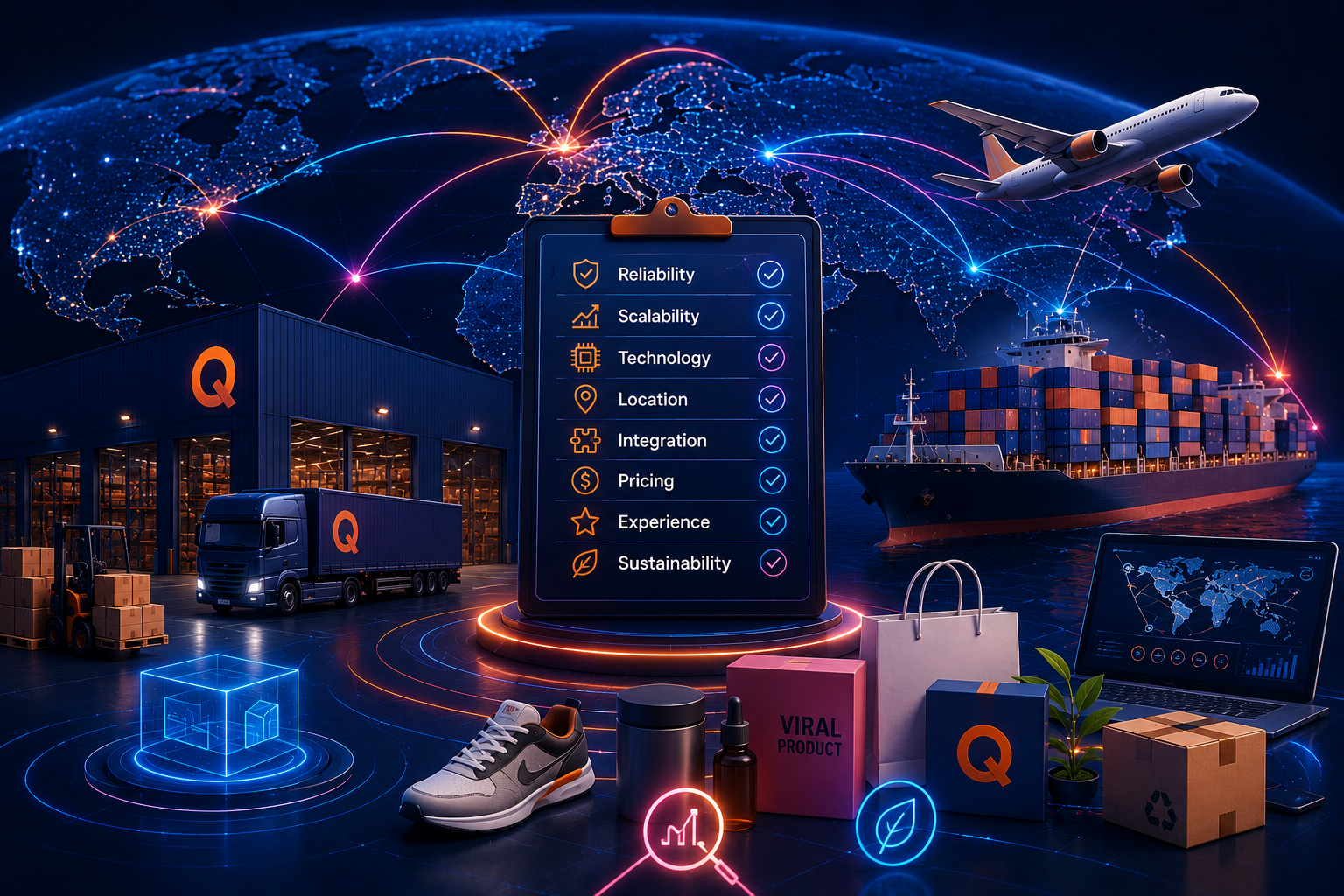
The Seven Factors That Matter Most
When evaluating providers, focus on the factors below.
1. Ecommerce Experience
Some logistics providers primarily serve wholesalers, manufacturers or retail chains.
Others specialise in ecommerce.
The difference matters.
An ecommerce-focused 3PL understands:
- direct-to-consumer shipping
- returns management
- platform integrations
- rapid order processing
- promotional spikes
Ask directly:
What percentage of your clients are ecommerce businesses?
The answer often reveals a lot.
2. Technology and Integrations
Technology is one of the biggest differentiators between fulfilment providers.
A strong ecommerce 3PL should integrate with platforms such as:
Shopify
WooCommerce
Amazon
TikTok Shop
Magento
Furthermore, visibility matters.
You should be able to access:
- inventory levels
- order status
- shipment tracking
- reporting data
Without reliable information, decision-making becomes harder.
3. Scalability
Many providers can handle your current volume.
The better question is:
Can they handle your future volume?
Consider:
seasonal peaks
promotional campaigns
international growth
product launches
A fulfilment partner should support where the business is going, not just where it is today.
4. Communication
Communication is often underestimated during provider selection.
Then it becomes the biggest complaint later.
Questions worth asking include:
How quickly do they respond?
Is support proactive or reactive?
Will you have a dedicated contact?
How are operational issues escalated?
Strong communication becomes particularly valuable during periods of rapid growth.
5. Pricing Structure
Pricing matters.
However, transparency matters more.
A quote should clearly explain:
- storage costs
- receiving fees
- pick and pack charges
- shipping costs
- returns handling
- additional services
Avoid focusing solely on the cheapest number.
Instead, focus on understanding the complete cost structure.
6. Geographic Coverage
Location affects:
- delivery speed
- shipping costs
- customer experience
A provider serving customers in one region may be unsuitable for another.
For example:
A business shipping primarily within Europe has very different requirements from a brand
serving North America or Australia.
Consequently, geographic alignment should form part of the evaluation process.
7. Operational Accuracy
Accuracy influences everything.
A fulfilment partner may offer attractive pricing, but frequent errors quickly eliminate any
savings.
Ask about:
- picking accuracy
- inventory accuracy
- dispatch performance
- quality control processes
The answers often reveal more than a sales presentation.
Common Mistakes When Choosing a 3PL
Many ecommerce brands make the same mistakes repeatedly.
Understanding them can help you avoid costly decisions.
Choosing on Price Alone
Low prices rarely compensate for poor service.
Ignoring Future Growth
A provider that works today may become a constraint tomorrow.
Not Checking References
Speaking with existing customers often reveals valuable insights.
Overlooking Returns
Returns handling has a direct impact on customer experience.
Assuming Every 3PL Is Similar
They are not.
Operational capabilities vary significantly.
Questions Every Ecommerce Brand Should
Ask
Before selecting a fulfilment partner, ask:
How quickly are orders dispatched?
What ecommerce platforms do you integrate with?
How do you handle returns?
What happens during peak periods?
How do you measure performance?
What support structure do clients receive?
How do you manage inventory accuracy?
The answers help separate strong providers from average ones.
Should You Switch Your Current 3PL?
Sometimes the best decision is not choosing a new provider.
It is improving the relationship with the current one.
However, there are circumstances where switching makes sense.
Common indicators include:
- declining service levels
- increasing errors
- poor communication
- lack of scalability
- rising costs without clear value
In these situations, exploring alternative options becomes sensible.
Another Industry Statistic
Research from Deloitte shows that businesses with highly efficient supply chains can
achieve significantly higher revenue growth and profitability than less mature competitors.
Source:
https://www2.deloitte.com/us/en/pages/operations/articles/supply-chain.html
Although supply chains involve many moving parts, fulfilment execution remains one of
the most visible components.
Thinking Beyond Fulfilment
The strongest ecommerce brands do not view a 3PL as a warehouse.
They view them as part of the customer experience.
Every order delivered correctly reinforces trust.
Every delayed parcel weakens it.
Therefore, selecting a 3PL for ecommerce is ultimately about supporting customer
satisfaction and sustainable growth.
Final Thoughts
Finding the right 3PL for ecommerce is not about chasing the lowest quote or the
biggest warehouse.
It is about identifying a partner that aligns with your products, customers, growth plans
and operational requirements.
The right provider can create efficiency, scalability and confidence.
The wrong provider can create friction at every stage of the customer journey.
Take the time to evaluate carefully.
The impact of that decision will often be felt long after the contract is signed.
FAQs
What does a 3PL do for ecommerce businesses?
A 3PL stores inventory, processes orders, ships products and often manages returns on
behalf of ecommerce brands.
How do I choose the right ecommerce 3PL?
Focus on experience, technology, scalability, communication, pricing transparency and
operational performance.
Is the cheapest fulfilment provider the best option?
Not necessarily. Service quality, reliability and scalability often have a greater long-term
impact than small pricing differences.
When should an ecommerce business start using a 3PL?
Typically when order volume, operational complexity or growth ambitions begin to
exceed internal capabilities.
Can a 3PL support international growth?
Many providers offer international shipping, multi-region fulfilment and cross-border
logistics support.



Comments
Share a question or insight about this article.