
EU €3 customs duty on low-value parcels: what it means for UK ecommerce brands
The EU charges €3 per item on parcels worth €150 or less, plus a €2 handling fee. How it hits UK brands, DDP vs DAP, landed cost and when EU stock pays.
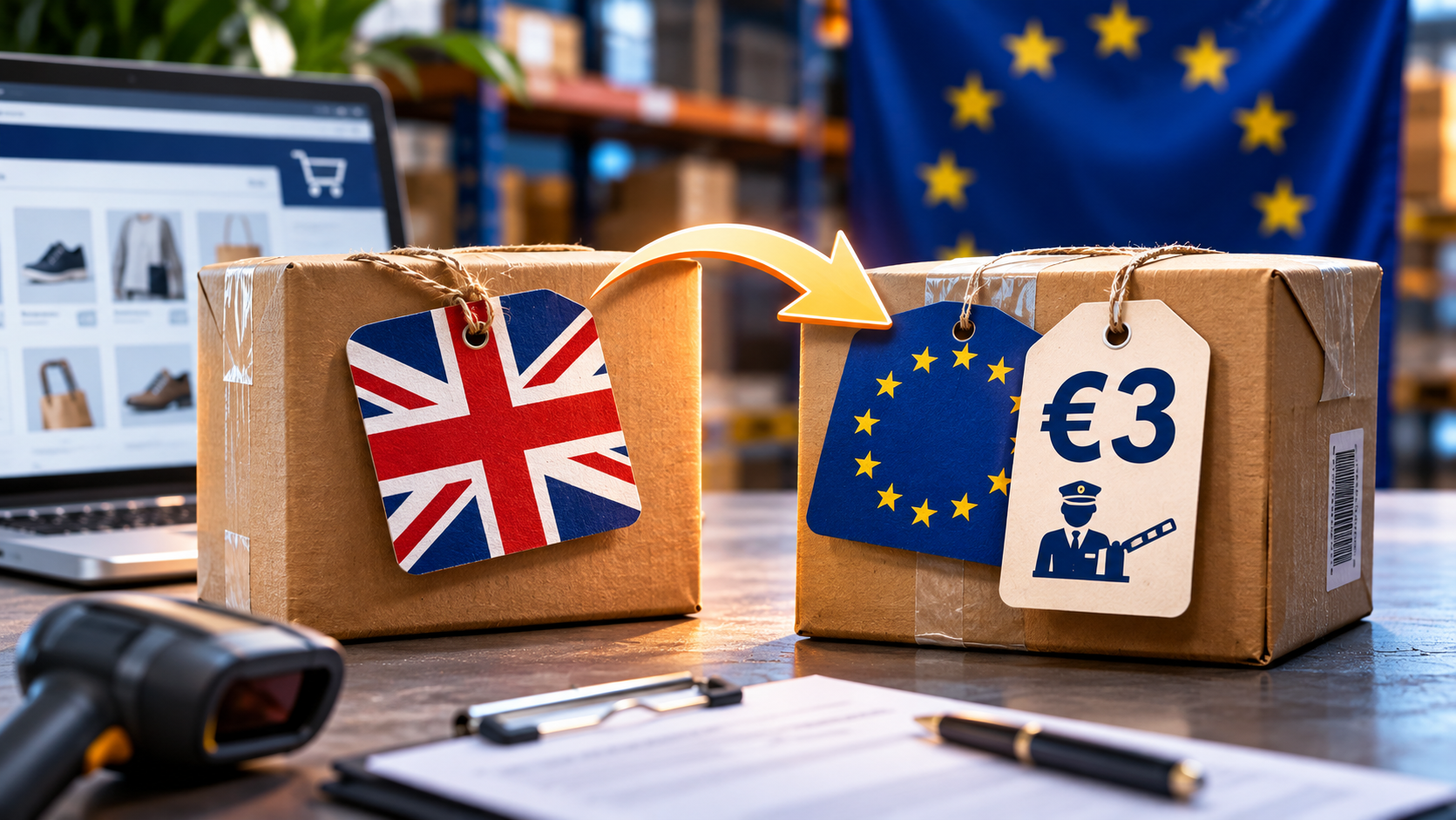
Since 1 July 2026, the EU charges a fixed customs duty of €3 per item on parcels worth €150 or less that are sold online to EU consumers from outside the EU, and that includes parcels sent from the UK. An "item" means each group of goods in the parcel that shares the same tariff classification, so five identical T-shirts cost €3 and a T-shirt plus a watch cost €6. The European Commission says this temporary duty runs until 1 July 2028, when normal duty rates take over.
On top of that, a separate €2 Union handling fee per item has applied since 1 November 2026. Below: who pays, DDP and DAP, landed cost per order, and when EU stock makes sense.
The pain points
"Our EU customers started getting asked for extra money at the door in July and some of them just refused the parcel."
"I priced EU shipping in spring. Now every order carries a charge I never built into the margin, and I don't know the real number."
"We make everything in the UK. I assumed the trade deal meant no duty, so why are we paying €3 a line?"
"Our carrier invoice has new lines on it and I can't tell which are EU charges and which are the carrier's own fees."
"Everyone keeps telling me to put stock in the EU, but I have no idea at what order volume that actually becomes cheaper."
What changed on 1 July 2026
Until 30 June 2026, goods sent to EU consumers in consignments worth €150 or less paid no customs duty, though VAT was already due from the first euro. Council Regulation (EU) 2026/382 removed that relief, and the €3 duty per item filled the gap while the EU builds its new customs data hub. The Commission's Access2Markets notice sets out the main points:
It applies to business to consumer distance sales of goods with an intrinsic value of €150 or less.
It applies whichever VAT route you use: IOSS, the special arrangements or standard import VAT.
An item is one or more goods in the consignment sharing the same tariff classification, and the duty is charged per declaration line.
The declaration type changes the count. On an H7 or H6 declaration, three products sharing a six or eight digit code can sit on one line and cost €3. On a full H1 declaration, which needs the ten digit TARIC code, the same three products can become three lines and cost €9.
Shipments to VAT registered business buyers pay standard duty rates, as FedEx's regulatory alerts note.
The €2 handling fee and national charges
The Union handling fee covers customs processing. Ireland's Revenue confirms it is €2 per distinct item on online purchases arriving from outside the EU, from 1 November 2026, with no value threshold, and that it is not refunded when goods are returned. The legal basis is Delegated Regulation (EU) 2026/2152.
A parcel under €150 with three different product types now carries €9 of duty and €6 of handling fee before VAT or carrier charges. Some member states add their own charges too: FedEx lists a Romanian logistics fee of 25 RON per shipment. National fees change often, so check with your carrier before you ship.
Who pays and how it is collected
Legally, the declarant owes the duty. The Malta Tax and Customs Administration names the seller or importer, an IOSS holder, a special arrangements user or their indirect representative. The consumer is liable only in rare cases. In practice the money reaches customs in one of two ways, described on the MTCA consumer page:
The seller collects the duty at checkout along with any VAT. This is how IOSS and DDP shipping work.
Nothing is collected at checkout, and the postal operator or courier asks the customer to pay before delivery. This is DAP.
IOSS covers consignments up to €150 and lets you charge EU VAT at checkout. Revenue's IOSS page adds that non-EU suppliers must appoint an EU intermediary, that excise goods are excluded, and that no VAT is charged on the €3 duty when IOSS is used. Our guide to DDP vs DAP for ecommerce covers the trade-offs. Under DAP your customer meets the duty, the handling fee and any carrier clearance charge at the door, which is where refused parcels come from.
UK-made goods and the preference route
The UK-EU Trade and Cooperation Agreement gives zero tariffs only to goods that meet the preferential rules of origin, proven with a statement on origin, as gov.uk's rules of origin guidance explains. Goods made in China and resold from the UK do not qualify.
The Commission's customs reform guidance says a preference can be declared on a full H1 declaration as long as IOSS was not used to collect the VAT. Through IOSS, the €3 applies whatever the origin. A UK-origin brand may avoid the €3 by shipping on H1 declarations with a valid origin statement. That route still pays the €2 handling fee and needs ten digit codes, and clearance may cost more per parcel. Ask your carrier for the H1 price and compare it with €3 per line before you switch.
How to recalculate landed cost per order
Work from real order data. For each EU order:
Count the distinct tariff classifications in the order. This gives the number of items for the duty and the fee.
Multiply by €3 for the duty and €2 for the handling fee.
Add any national fee for the destination country and any carrier clearance or disbursement fee.
Add EU VAT at the destination rate, as you already do.
Set the total against the order margin and your landed cost model.
Keep your HS codes accurate, because a wrong code can split one line into two. A three product bundle carries three times the fixed charges of a single product.
When EU stock starts to pay
The MTCA confirms that no customs duty applies to goods shipped to consumers from within the EU, and Revenue's handling fee page limits that fee to parcels arriving from outside the EU. When you hold EU stock, you import in bulk as a business import at standard duty rates, which for UK-origin goods with a valid origin statement can be zero. You then pay EU fulfilment fees, pallet freight, and the VAT and set-up costs of holding stock in that country, which our guide to EU fulfilment for UK brands covers in detail.
The break-even depends on three numbers: monthly EU orders, average distinct items per order, and the extra cost per order of EU fulfilment over UK fulfilment. High order counts and multi-product baskets reach it first. The State of Ecommerce Fulfilment 2026 report sets these duty changes alongside the other cost shifts brands face this year.
What to ask a 3PL
Do you ship EU parcels on H7 or H1 declarations, and can I see how my last month of orders was declared?
What do you charge per parcel for customs clearance, and is that separate from the €3 duty and €2 handling fee?
Can you pass my statement on origin through to the EU declaration for UK-origin goods?
If I move stock into the EU, what are your inbound, storage and per-order fees, and how fast can you start?
How do you handle returns from EU customers, given the handling fee is not refunded?
Our recommendation: reprice EU orders from real order data this month
Export three months of EU orders and count the distinct tariff codes in each one.
Apply €3 and €2 per item, plus national and carrier fees, to get a true landed cost per order.
Check your HS codes and fix any that split one product type across two lines.
Move EU sales to DDP so customers are not asked for money at the door.
If your goods are UK origin, price H1 clearance with a statement on origin against the €3 per line.
Run the EU stock break-even with quotes from at least two EU fulfilment partners, using the guide to choosing a 3PL to compare them.
What waiting costs
Every EU parcel you send without these charges priced in comes out of your margin, and multi-product orders lose the most. DAP parcels that customers refuse come back at your cost, and the handling fee on them is gone. The temporary duty ends on 1 July 2028, when normal duty rates apply, so the numbers will move again.
These figures are made up to show the method. A UK apparel brand ships 800 EU orders a month from the UK, with an average of 2.5 distinct items per order. Duty is 2.5 times €3, or €7.50, and the handling fee is 2.5 times €2, or €5, so €12.50 per order and €10,000 a month before VAT and carrier fees. Moving to EU stock adds €2.20 per order in extra fulfilment cost and €1,200 a month in pallet freight and storage, a total of €2,960. On these figures, EU stock saves about €7,000 a month. At 150 orders with 1.2 items each, the per-order charges come to €900 against roughly €1,530 of EU stock costs, and shipping from the UK stays cheaper.
People Also Ask
Is the EU €3 customs duty charged per parcel or per item?
Per item. An item is a group of goods in the parcel that share the same tariff classification, so five identical shirts count once and a shirt plus a watch count twice.
Does the €3 duty apply to parcels from the UK?
Yes. It applies to low-value distance sales into the EU from any non-EU country, including the UK. UK-origin goods can claim the trade agreement preference only on an H1 declaration and only when IOSS was not used to collect the VAT.
Is the €2 handling fee the same thing as the €3 duty?
They are separate charges, both due on the same parcel. The €3 is a customs duty on parcels worth €150 or less. The €2 Union handling fee applies per distinct item from 1 November 2026 with no value threshold.
Finding the right EU fulfilment partner
Logan, FulfilQ's advisor on the website, matches brands to verified providers by order volume, product type and region. Tell Logan your monthly EU orders, your average items per order and where your goods are made, and you get a shortlist to ask about EU stock, H1 clearance and per-parcel customs fees. Start at fulfilq.com and Ask Logan, or Submit an RFP and verified providers come back to you. You can also browse the full provider directory.



Comments
Share a question or insight about this article.