
Delivery options at checkout: how many to offer and how they affect cart abandonment
How many delivery options to offer at checkout, which ones UK shoppers choose, and how cut-off times, 3PL capacity and free delivery affect cart abandonment.
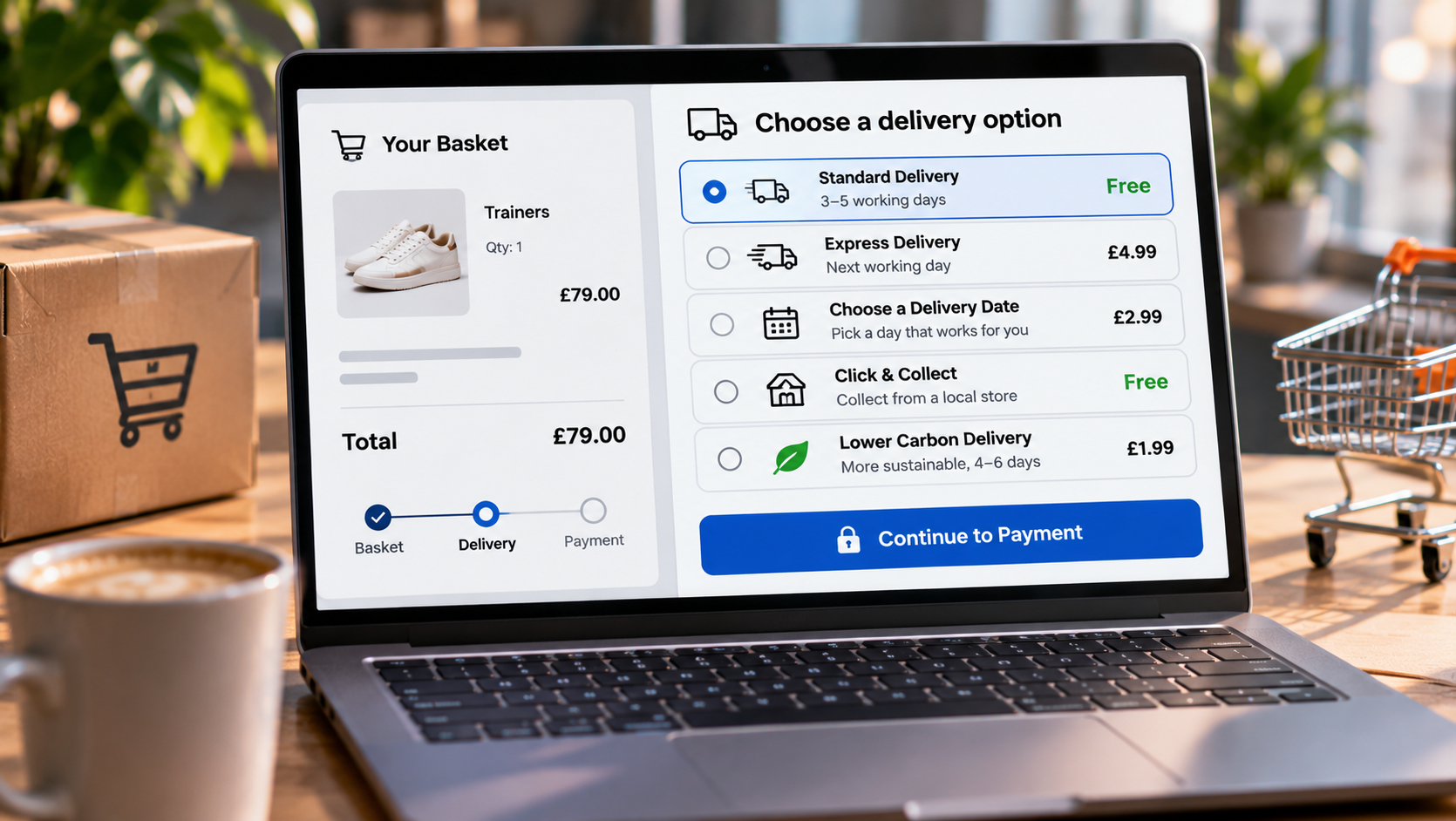
Most UK ecommerce brands should offer three delivery options at checkout: standard tracked delivery, paid next day and one parcel locker or pickup point option, each shown with a delivery date. In Sendcloud's 2026 Delivery Compass, 50.5% of European shoppers said they are more likely to complete a purchase when they can choose between delivery options, and 54.5% of UK shoppers had abandoned a basket over delivery in the previous three months. Every option you show must be one your 3PL and carriers can keep, because a broken delivery promise does more harm than a missing option.
This guide covers which options to offer, how to show an honest date, how cut-off times and warehouse capacity set what you can promise, free delivery thresholds and testing. The survey figures come from vendor-run research, so treat them as directional. They match the pattern in FulfilQ's State of Ecommerce Fulfilment 2026 report.
The pain points
Shoppers get as far as the delivery step and then leave. I can see the drop but I can't tell what puts them off.
We added next day and plenty of those orders still arrive two days later, so customer service spends Monday apologising.
Our checkout says 3 to 5 working days. Nobody is sure whether that counts today or the weekend, including us.
Customers keep asking for lockers and I don't know if our warehouse can label for them.
We raised the free delivery threshold to protect margin and I have no idea whether it cost us orders.
Why delivery decides whether a basket converts
Baymard Institute puts the average documented cart abandonment rate at 70.22%, across 50 studies. In its survey of US shoppers who left during checkout, excluding those just browsing, 40% said extra costs such as shipping, tax and fees were too high, 20% said delivery was too slow and 12% couldn't see or calculate the total cost up front.
Sendcloud surveyed 8,000 shoppers in eight European markets for its E-commerce Delivery Compass 2026, and 40.7% named unexpected delivery costs as their main reason for abandoning. Ingrid's Delivery Economics 2026 report, based on a Savanta survey of 1,022 UK shoppers in March 2026, found 37% had abandoned a cart and bought elsewhere because of delivery, and 55% named inaccurate delivery times as their top frustration.
The law applies too. The Consumer Contracts Regulations 2013, Schedule 2, require you to give any additional delivery charges and the time by which you undertake to deliver before the shopper is bound. Under section 28 of the Consumer Rights Act 2015, if no time is agreed you must deliver without undue delay and within 30 days. If a date was agreed and timely delivery was essential, the customer can treat the contract as at an end and you must refund them. Take legal advice before you rely on particular wording.
Which delivery options to offer
Asked what they would choose at checkout, Sendcloud's shoppers put standard home delivery first on 30.6%, then next day on 10.7%, service point pickup on 10.3%, parcel locker on 9.2% and nominated day on 8.8%. In practice, 45.3% had used somewhere other than home in the last three months.
Standard tracked delivery: your default and usually your cheapest honest option. Royal Mail says Tracked 48 aims to deliver in two to three working days. Check each carrier's own service aims.
Next day: offer it only when your cut-off and capacity support it. Royal Mail gives Tracked 24 a next working day delivery aim and notes that aims may not apply to some postcodes, so your checkout needs to handle those.
Lockers and pickup points: suit shoppers who are out during the day and can't wait in for a parcel. Your 3PL must be able to label for each network, and each network has its own size limits. Our guide to Royal Mail alternatives for brands covers the main carrier options.
Nominated day: useful for gifts, bulky items and high-value orders. Add it once your order data shows demand.
Order and defaults also shape the result. In Ingrid's Swedish data, retailers offer two to four shipping methods on average, 61% of orders use the top-placed option and 68% the pre-selected one. Put first the option you can most reliably deliver on time.
Show a delivery date worked out from your real cut-off
Baymard found 41% of sites in its checkout benchmark don't show a delivery date. Labels such as "2 business days" leave shoppers guessing whether today counts and whether weekends are included, and testers given the same information reached different answers. Baymard recommends a date or date range beside each option, calculated from when the parcel actually leaves the warehouse.
Check the order time against your 3PL's cut-off for that carrier service.
Dispatch today if before cut-off, or the next working day if after.
Add the carrier's transit aim, skipping days the service doesn't deliver.
Show a date, or a short range for slower services.
Our guide to 3PL order cut-off times explains how cut-offs are set. Ingrid found 75% of UK shoppers would trust a retailer more if delivery estimates were based on real-time data, so pull dates from your carrier or shipping software where you can.
Let warehouse capacity set the promise
A delivery date is only as honest as the warehouse behind it. A 2pm cut-off means little if Monday's backlog or a weekend promotion pushes orders into the next day's pick. Ask your 3PL for its daily dispatch capacity for your account and what happens to orders above it.
Then link the checkout to that reality. Hide next day when the backlog is over capacity, and push dates out during peak and bank holidays. Sendcloud found 42.5% of shoppers blame the online store for a delivery problem even when the carrier handled it, and 29.1% chose not to reorder after a delivery failure. Capacity and cut-off commitments belong in your 3PL selection, covered in our guide on how to choose a 3PL for your ecommerce brand.
Set a free delivery threshold you can afford
Sendcloud found 71.8% of shoppers prefer free delivery to paid next day. A free standard option above a threshold is one of your strongest levers, provided the threshold covers your real cost per order. Our guide to free shipping thresholds and fulfilment cost shows how to set one from your average order value and your 3PL and carrier charges.
Show the threshold in the basket with how much more the shopper needs to spend, so delivery cost never surprises them at the last step. Ingrid reports retailers that tested fees and thresholds recovered 12% to 82% more shipping revenue. Those are vendor case studies, so test your own.
How to test changes to delivery options
Change one thing at a time: an option, the default, the order, the date display or the threshold.
Measure completion from the delivery step to payment, option mix, delivery revenue against carrier cost and on-time delivery.
Run each test for at least two full weeks outside peak and promotions, and exclude staff and test orders.
Check on-time delivery after the test. Extra orders that arrive late are a loss.
What to ask a 3PL
What are your cut-off times for each carrier service you would use for my orders, including Saturdays?
What is your daily dispatch capacity for my account, and what happens to orders above it?
Which locker and pickup point networks can you label for, and what are the size limits?
Can you pass dispatch dates or service availability to my checkout or shipping software?
How quickly will you tell me when a cut-off is going to be missed?
Our recommendation: offer three dated options you can keep
Pull three months of orders with order time, service chosen and actual arrival date.
Get your 3PL's cut-off and daily capacity for each carrier service in writing.
Offer standard tracked as the pre-selected default, paid next day and one locker or pickup option.
Show a delivery date beside each option, calculated from cut-off and transit aim.
Check your free delivery threshold against your full cost per order and show it in the basket.
Test one change at a time for at least two weeks, then check on-time delivery as well as conversion.
What waiting costs
Each month vague delivery wording stays live, some shoppers who reach the delivery step leave and buy elsewhere. Each next day promise the warehouse can't keep adds customer service contacts, refunds and customers who don't return. An unchecked threshold either leaks margin on every order or holds basket size down.
Take a brand where 4,000 shoppers a month reach the delivery step and 30% leave there, which is 1,200 shoppers. If clear dates and a locker option bring back 5% of them, that is 60 extra orders a month. At an average order value of £45, that is £2,700 a month, or £16,200 over six months. If the brand also sends 300 next day orders a month and 10% arrive late, that is 180 disappointed customers over the same six months. These figures are made up to show the method.
People Also Ask
How many delivery options should I offer at checkout?
Three suits most UK brands: standard tracked, paid next day and one locker or pickup option. Ingrid's Swedish data shows retailers offering two to four on average. Add more only where order data shows demand and your 3PL can deliver on each.
Should I show a delivery date or a number of working days?
Show a date. Baymard found shoppers given working-day ranges reached different answers about arrival, and recommends a date or short date range beside each option, calculated from your real cut-off.
Do parcel lockers reduce cart abandonment?
No public study isolates that effect for UK brands. Sendcloud found 45.3% of European shoppers used an out-of-home option in the last three months. Add a locker option and measure completion at the delivery step before and after.
Finding the right 3PL partner
Logan, FulfilQ's advisor on the website, matches brands to verified providers by order volume, product type and region. Tell Logan your monthly orders, the delivery options you want at checkout and the carriers you use now, and you get a shortlist to ask about cut-off times, daily capacity and locker labelling. Start at fulfilq.com and Ask Logan, or Submit an RFP and verified providers come back to you. You can also browse the full provider directory.


Comments
Share a question or insight about this article.