
Australian biosecurity rules for ecommerce imports
How BICON, wood packaging rules and used-goods cleaning requirements catch ordinary ecommerce shipments into Australia, and what referral costs you.
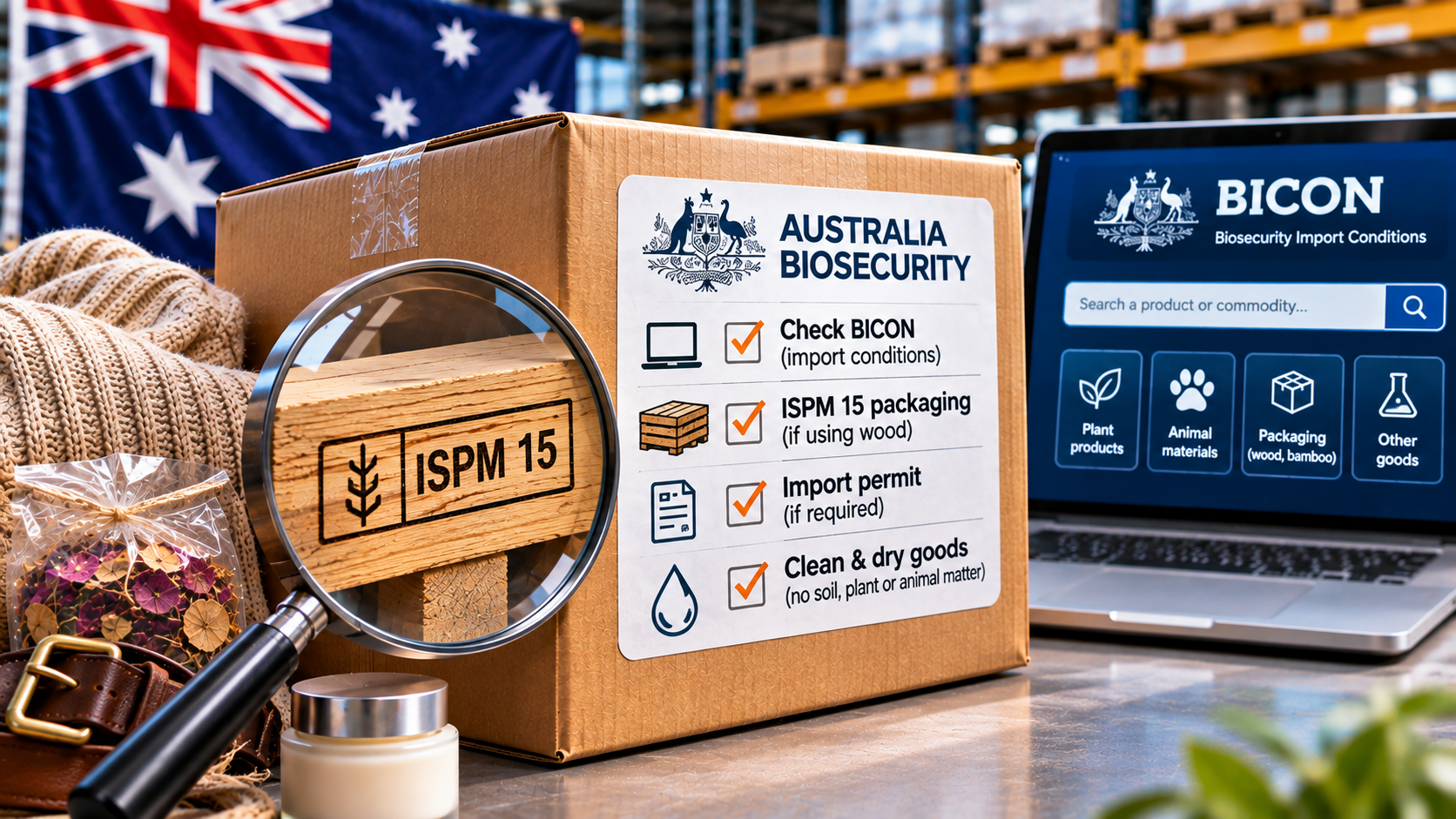
Biosecurity control applies to every consignment entering Australia, not just the obvious plant and food items. Wood packaging, animal-derived materials, used equipment and even some cosmetics can trigger a hold, a treatment charge or a destroyed shipment if you haven't checked BICON, Australia's biosecurity import conditions database, before you ship. If you're importing bulk stock rather than shipping direct to customers, our guide to importing stock into Australia covers the customs declaration and duty side separately.
Last checked: 7 November 2026. The Department of Agriculture, Fisheries and Forestry's own site blocked direct access during this research, so figures and specific conditions below are reported from search-indexed page content rather than a live read. Check the live BICON case for your product, and the department's current fees page, before you rely on any figure here for a real shipment.
The pain points
"Our parcel got held at the border and nobody told us wood packaging was the reason until it had already sat there a week."
"We send gift sets with dried botanicals in them and I don't know if that counts as a plant product."
"A customer's return of used outdoor gear got flagged, and now I don't know what we're meant to do with it."
"I can't find a straight answer on whether our packaging needs an ISPM 15 stamp or not."
"Nobody can tell me what it actually costs if a consignment gets referred for inspection."
What BICON is, and how to use it
Every good arriving from outside Australia is subject to biosecurity control under the Biosecurity Act 2015. BICON, the Biosecurity Import Conditions system, is the government's online database covering more than 20,000 case types across plant, animal, mineral and biological products. You don't need an account to search import conditions, only to apply for and track an import permit. The department's own advice is to search BICON by product before you ship, to find out whether it's permitted, needs a permit, needs treatment, or carries other conditions, and that advice applies just as much to an ecommerce parcel as to a commercial import.
Ecommerce categories that get caught, even though they don't look like quarantine items
Items containing wood, bamboo or straw: packaging dunnage, gift boxes with straw filler, and some decorative items can fall under timber and packaging conditions, covered separately below.
Animal-derived material: horns, bones, teeth, shells, fully tanned leather, hides, furs and skins are generally importable once clean and free of soil, seed or animal and plant debris, with untanned rawhide inspected on arrival and anything from a CITES-listed species separately controlled.
Cosmetics and skincare: plant ingredients are generally permitted; animal-derived ingredients need checking against the specific BICON case for that ingredient before you ship.
Anything that's been in contact with soil, sand or water: treated as high risk unless it's clean and free of organic matter; an import permit may be required if soil contamination is identified.
Used goods and equipment: used sporting, camping and outdoor equipment, and anything that's held standing water, must be clean and dry on arrival, or it may need treatment, re-export or destruction at your cost.
Wood packaging and ISPM 15
ISPM 15, the international standard for wood packaging material, is built into BICON's own conditions. Solid timber packaging and dunnage that hasn't been treated and marked to ISPM 15, or didn't receive an acceptable offshore treatment, faces mandatory treatment on arrival in Australia, or may be re-exported or destroyed at the importer's expense. Timber and bamboo packaging must meet DAFF's import conditions, which often means ISPM 15 treatment and marks. Check BICON for the exact rule for your packaging.
What happens when a consignment is referred for inspection
A referred consignment goes through a chain of cargo directions such as inspection, treatment and release, at the importer's cost. Treatment options include fumigation, heat treatment, irradiation, gas treatment or steam cleaning for soil contamination, or export back to the sender, or destruction, depending on what's found. DAFF fees changed on 1 July 2026, so check the current charging guidelines on agriculture.gov.au before you budget. DAFF doesn't publish a standard turnaround time either; the delay depends on what inspection and treatment your consignment needs, so treat any specific number of days quoted by a freight forwarder as their own estimate, not a published guarantee.
Import permits
Some product categories need a Biosecurity Import Permit, applied for and tracked through a BICON account, with its own application charge plus an assessment fee that varies by category. The department won't assess a permit application until the charge and fee are both paid, and being accepted for assessment doesn't guarantee the permit is issued. DAFF fees changed on 1 July 2026, so check the current charging guidelines on agriculture.gov.au before you budget, rather than a figure from before that date.
Goods sent by post are handled differently
Self-Assessed Clearance, the simplified pathway for cargo valued AUD $1,000 or less, explicitly doesn't apply to goods arriving by international mail. International mail is instead screened at mail centres by X-ray, detector dog and manual inspection, and can be selected for inspection even with no declared risk item. The department's guidance for online sellers asks merchants selling to Australian customers to comply with Australian biosecurity law, check BICON for their goods, and avoid vague customs descriptions such as "gift." Goods that don't meet import conditions when mailed may be exported or destroyed. If you ship to Australian customers by courier as freight rather than through the postal network, ask your carrier which clearance pathway it uses, since the rules differ.
What to ask your freight forwarder or 3PL
Have you checked the current BICON case for each of our products, including packaging materials, not just the goods themselves?
Does any of our packaging use solid timber or bamboo, and is it ISPM 15 treated and marked?
If a consignment is referred for inspection, who pays, and what's your estimate of the cost and the delay?
Do any of our products need a Biosecurity Import Permit, and have you applied for it already?
For returned or used items coming back from Australian customers, what cleaning or treatment do we need before they're resold or disposed of?
Our recommendation: check BICON before you ship, not after a hold
Search BICON for every product and packaging material you send to Australia, not just the obvious plant or food items.
Confirm your wood or bamboo packaging is ISPM 15 treated and marked, or switch to packaging that doesn't need it.
Apply for any Biosecurity Import Permit your products need before you ship, not after a hold.
Set a clean, dry standard for any used or returned goods before they're reshipped.
Check the department's current charging guidelines on agriculture.gov.au before you budget, since DAFF fees changed on 1 July 2026.
What waiting costs
A consignment held at the border for an unchecked biosecurity condition costs you the inspection and treatment fee, the delay, and in the worst case the value of goods that are destroyed, on top of whatever you already paid to ship them.
These figures are made up to show the method. A brand sends a monthly consignment of gift sets with straw packing material it hasn't checked against BICON. One shipment is referred, costs an illustrative $300 in inspection and treatment fees, and is held for a week, missing a promotional launch date. Checking BICON first and switching to a packaging material that doesn't trigger a referral removes that $300 and the week's delay on every future shipment. These figures are made up to show the method.
People Also Ask
Does BICON apply to ordinary ecommerce parcels, or only commercial freight?
It applies to any goods entering Australia, including parcels sent by post, though the clearance pathway differs: Self-Assessed Clearance doesn't apply to international mail, which is screened separately. Check BICON for your product regardless of how you ship it.
Does our wood or bamboo packaging need treatment before we ship to Australia?
Solid timber packaging generally needs ISPM 15 treatment and marking, or it faces mandatory treatment on arrival, re-export or destruction at your cost. Timber and bamboo packaging must meet DAFF's import conditions, which often means ISPM 15 treatment and marks, so check BICON for the exact rule for your packaging.
Who pays if our consignment is referred for biosecurity inspection?
The importer bears the inspection, documentation and any treatment cost. DAFF fees changed on 1 July 2026, so check the current charging guidelines on agriculture.gov.au before you budget, rather than relying on an old figure.
Finding the right fulfilment partner in Australia
Logan, FulfilQ's advisor on the website, matches brands to verified providers by order volume, product type and region. Tell Logan what your products and packaging are made of, and you get a shortlist to ask about biosecurity checks, permits and how they handle a referred consignment. Start at fulfilq.com and Ask Logan, or Submit an RFP and verified providers come back to you. You can also browse the full provider directory.

Comments
Share a question or insight about this article.